
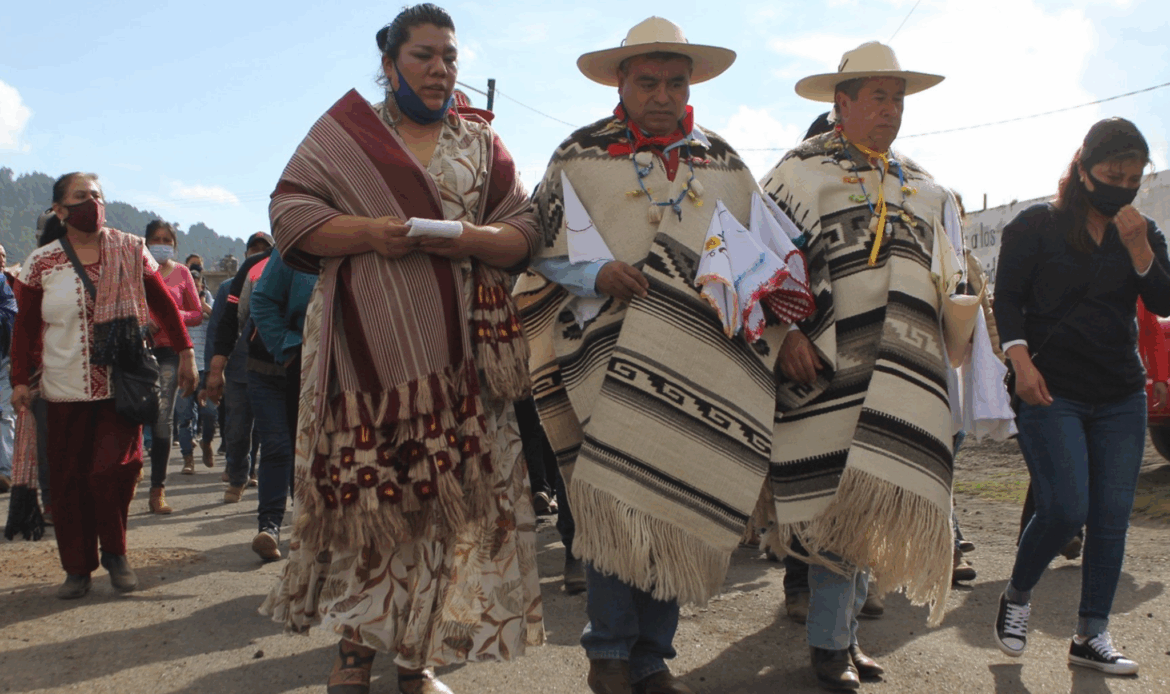
José Antonio Arreola remembers the early morning when he had to leave his home, his wife, and his young children, with only a fellow activist by his side for support. Threats from organized crime forced him to flee Nahuatzen, the P’urhépecha Plateau community where he was born and raised, and which he fought to protect.
He left behind the rich forests, a town rooted in Indigenous culture, and its people—but he still thinks of returning to continue the struggle for the recognition and defense of autonomy and security in his community.
The situation in Nahuatzen, Michoacán
The situation in Nahuatzen, Michoacán, in western Mexico, is extremely critical. Criminal networks are fighting for control of Indigenous territories—either for their timber resources or due to their strategic location for trafficking illegal goods—and their influence over municipal government institutions is increasingly evident.
In this context, Indigenous human rights defenders face extreme risks, becoming targets of threats, harassment, and serious violations of both their individual and collective rights, especially when they exercise their right to self-determination.
José Antonio Arreola embodies this struggle
José Antonio Arreola embodies this struggle. In 2015, he served as a representative of the Indigenous Citizens’ Council of Nahuatzen (CCIN), a community government formed through a community assembly in response to insecurity, corruption, and state neglect.
Two years later, the CCIN was officially recognized by the Electoral Tribunal of the State of Michoacán and by the Federal Government as an Indigenous authority.
But this recognition also marked the beginning of a new phase of repression.
Obstruction of autonomous governance
State government officials—especially under the orders of Silvano Aureoles (Governor from 2015 to 2021)—refused to acknowledge the CCIN and continued supporting the municipal government, despite the Electoral Tribunal’s ruling recognizing the CCIN as the legitimate authority. This action obstructed the exercise of Nahuatzen’s autonomous governance.
The persecution intensified with threats, smear campaigns, and political harassment.
Violent arrest and arbitrary imprisonment
On November 14, 2018, José Antonio was violently arrested at his own home. During the raid, his young children had guns pointed at them and were threatened by police officers [1].
He was baselessly accused of violent robbery and sabotage against the Nahuatzen City Council and was later sentenced to seven years in prison at the “Lic. Eduardo Ruiz” Penitentiary in Uruapan.
José Antonio was released in 2022 thanks to a ruling by the Supreme Court of Justice of the Nation, which found that the alleged crime could not be proven during trial.
Return, commitment, and renewed threats
Upon release, he did not abandon his commitment. Concerned about the rise in substance abuse in his community, he led the creation of a rehabilitation center for Indigenous youth:
“When I returned, I was shocked to see how many families were selling drugs. If security were in the hands of the community, things would be different.”
His leadership again became a threat. In 2025, he was once again targeted with threats by organized crime. For his safety, he was forced to flee.
He left in fear, but also with hope—the hope that one day, his community could live in peace and dignity.
Organized crime in Nahuatzen
“There are armed, masked men who don’t belong to the community. I can’t be there now, but together with other organizations we are working to have our autonomy recognized and to return in peace,” he explains.
His family is now separated, living in fear and subjected to a system that combines armed violence with impunity.
In Nahuatzen, as in other Indigenous communities in the region, organized crime follows a distinct pattern. First, they burn the forests, then they buy or forcibly take the land. They exploit conditions of vulnerability, fear, and despair to gain entry into the territory.
Corruption and institutional neglect allow this to happen. Local residents denounce the silence of the state government, while the federal government fails to act.
A weakened social fabric
In the meantime, entire communities lose not only control over their territory, but also trust in the authorities that should be protecting them. This double loss deeply weakens their traditional forms of organization.
Community assemblies are no longer recognized, traditional leaders are criminalized or co-opted, and the social fabric is torn apart by fear and forced displacement.
External projects are imposed without consultation or respect, disrupting community life plans and undermining the autonomy that Indigenous peoples have defended for generations.
Defending collective rights at great personal risk
“If they see us meeting at a comrade’s house, they threaten us. They’re trying to wear people down. But with so much injustice, we cannot give up. We’re trying to put fear aside and keep organizing ourselves,” José Antonio states firmly.
Today, defending collective rights means putting one’s life at risk. In territories where those who should protect Indigenous peoples serve other interests, defending the land becomes an act of courage.
UN concerns over criminalization
The UN Special Rapporteur on the situation of human rights defenders, Mary Lawlor, has expressed concern over the arbitrary detention of Indigenous human rights defenders in Mexico and the imposition of harsh sentences.
The combined sentences of nine of the 10 defenders referred to in her November 2024 communication totaled nearly 300 years in prison [2].
Collective support and solidarity
This is why collective efforts are key. Like other Indigenous defenders, José Antonio has received support from Serapaz, Voces del Territorio, Red Solidaria, Front Line Defenders, and Indigenous Peoples Rights International, which offer accompaniment in territorial defense processes and peacebuilding.
Calling for structural action
In light of this reality, beyond denouncing violations of individual and collective rights, Indigenous peoples are calling for action on the structural roots of the crisis through decisive measures:
recognizing community security systems such as communal patrols, guaranteeing the right to self-determination, and strengthening Indigenous autonomy and governance systems.
Only then will it be possible to rebuild the hope of returning to their territories in peace.
Support from IPRI’s Legal Defense and Sanctuary Fund
IPRI’s Legal Defense and Sanctuary Fund (LDSF) provided support to José Antonio Arreola to ensure safety, sustenance, and communication capacity during his temporary refuge, as well as to prepare resources for a possible emergency evacuation.
This support enables him to continue his struggle for his community’s right to autonomy and security.
References
[1] National Network of Civil Society Organizations “All Rights for Everyone” (Red TDT). Final Report of the Civil Observation Mission: “Autonomy and Self-Determination in the P’urhépecha Plateau” (Michoacán, February 17–20, 2020). Red TDT, Michoacán, Mexico, 2021.
[2] OHCHR, “Mexico: UN expert concerned about criminalization, arbitrary detentions, and long sentences for indigenous defenders,” November 8, 2024. https://www.ohchr.org/es/press-releases/2024/11/mexico-un-expert-concerned-over-criminalisation-arbitrary-detention-and-long
