
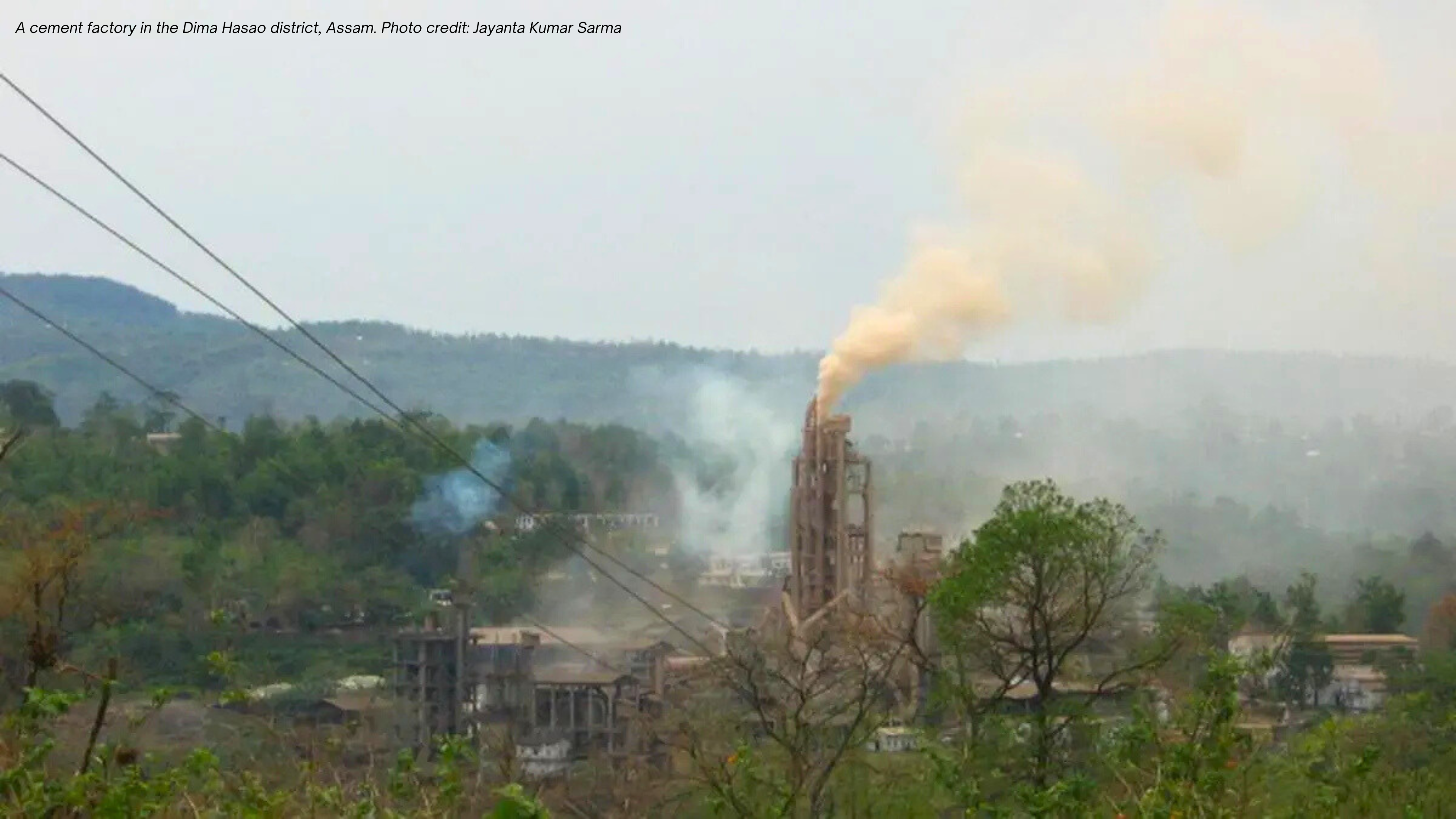
 The Government of Assam allotted 2,000 bighas of tribal lands to a private cement company, Mahabal Cements Pvt. Ltd., in the Dima Hasao district of Assam through an allotment Order dated 14.10.2024. Subsequently, an adjacent parcel of 1 000 bighas was also allotted to the company via a second allotment Order dated 12.11.2024 [1] , bringing the total area to 3 000 bighas (approximately 1 000 acres) for the establishment of a cement plant. In February 2025, Mahabal Cement Pvt Ltd, which is a subsidiary of the JK Lakshmi Cement Company, signed a memorandum of understanding (MoU) worth Rs 11000 cores ($1.33 billion USD) with the Assam government for setting up the cement factory. [2] Court records show that the company began preliminary activities such as fencing and boundary works on the allotted land. As per the government’s submission before the Court, the lands so allotted will be used for an integrated cement factory on the allotted land, which will also include industrial set up such as plants and machinery, coal-based captive power plant, road infrastructure, rail siding, solar plant project, truck parking, residential areas, etc. Several villages shall be directly affected, particularly the village of Nobdi Longkukro, inhabited by the Dimasa tribe, and Choto Larpheng inhabited by the Karbi tribe. Community members allege that the government allotted their ancestral land without free, prior, and informed consent, and without following due process. [3] Allegations include instances of villagers being coerced into signing No Objection Certificates (NOCs). [4] Some landowners in Nobdi Longukro reportedly received a lump sum compensation of only Rs. 200000 (around 2200 USD), which many villagers refused and returned. [5] Nobdi Longukro is home to over 35 tribal families [6] , while Choto Larpheng village had a population of 50 families as per the 2011 Census. [7] While Nobdi Longukro and Choto Larpheng face direct eviction and displacement, almost 30 other villages including Borolokhindong, Sikilangso, Checkso, Borolobang, and Chotolobang stand to lose their lands. These villages will be directly affected due to the development of the cement plant, through the construction of roads and other facilities, as well as the loss of agricultural lands traditionally used for shifting cultivation by the local Karbi and Dimasa indigenous communities. A community leader estimates the total number of families that will be affected by the cement plant to be around 1,500, of which approximately 300 families will be directly affected. Local communities have strongly opposed the proposed cement factory. They argue that the project will lead to displacement, disrupt traditional agriculture, and result in the loss of lands, water resources, and the ecological balance, all of which could disrupt livelihoods and cultural identity. Traditionally, the Dimasa and Karbi peoples practice shifting cultivation or jhum cultivation and it is the primary means of livelihood. The establishment of the cement plant, and the large tracts of forest lands allotted to the company, means that these families will be left with very little land to continue this traditional practice. This shall threaten their food security. There are also widespread concerns about pollution and its potential long-term health impacts. On September 3, 2025, the Gauhati High Court also flagged the potential ecological impact of the cement plant’s operations. The Dima Hasao district falls under the North Cachar Hills Autonomous Council (NCHAC), which was established under the Sixth Schedule of the Indian Constitution. The Sixth Schedule applies to tribal regions in the states of Assam, Meghalaya, Mizoram, and Tripura and grants autonomous district councils the power to protect the land, resources, cultural heritage, and self-governance of tribal communities. The district is predominantly inhabited by the Dimasa, Karbi and other tribal communities. Notably, 92% of Dima Hasao is under forest cover. [8] The tribal population of the district primarily rely on jhum or shifting cultivation. The region is rich in mineral deposits, especially limestone, which is essential for cement production. The area is also considered an ecologically sensitive zone, known for its hot springs, migratory bird habitats, and biodiversity. Petition by tribal landowners and counter petition by the company In response to the threat of imminent eviction and displacement, 22 tribal landowners from Nobdi Longkukro and Choto Larpheng, including lead petitioner Sonesh Hojai, filed a writ petition before the Gauhati High Court on December 20, 2024. [9] They alleged that the government had allotted their ancestral lands without proper demarcation or due process, and without community consultation. On January 21, 2025, Mahabal Cements Pvt. Ltd. filed a counter-petition [10] seeking protection from what it called “disturbances created by local villagers”. The company also sought action against three individuals, namely Sonesh Hojai, Samarjit Nunia, and Sabjaynon Jidung, for allegedly obstructing construction activities. A complaint had been previously filed on December 27, 2024, at Umrangso Police Station against these individuals. It was reported that on September 2, 2025, police arrested six tribal villagers in Dima Hasao, including three of the petitioners. [11] They were, however, released on bail the same night. [12] Interventions by the Gauhati High Court Hearings in the case have been ongoing before the Gauhati High Court for the past few months. During a hearing on August 12, 2025, presided over by Justice Sanjay Kumar Medhi, the Court expressed serious concerns over the ‘extraordinary’ scale of land allotted to a private company within a Sixth Schedule area, where tribal rights and interests are constitutionally protected. Justice Medhi, during the course of the hearing, remarked: 3000 bighas! The entire district? What is going on? 3000 bighas allotted to a private company? We know how barren the land is… 3000 bighas? What kind of decision is this? Is this some kind of joke or what? Your need is not the issue… the public interest is the issue. The Court directed the North Cachar Hills Autonomous Council (NCHAC) to submit records of the policy under which such a large-scale allotment of tribal lands was made. On September 3, 2025, the Advocate General of Assam informed the Court that out of the 3,000 bighas, 1,020 bighas were designated as a “green belt” and the remaining land would be used for plant infrastructure, a solar energy facility, and township development. However, the Court remained unimpressed by the state’s submissions. Justice Medhi reiterated his concerns about potential environmental degradation caused by the project, violation of tribal rights guaranteed under the Sixth Schedule of the Constitution. The next hearing of the case is scheduled for September 24, 2025. [1] . Court order dated 29.01.2025 in WP(C) No. 337/2025 [2] Sukrita Baruah, “After Gauhati HC questioned 3,000 bigha allotment to cement company in Assam’s tribal district, state responds: Don’t want to drive away investment”, Indian Express, Sept. 04, 2025. https://indianexpress.com/article/india/after-gauhati-hc-questioned-3000-bigha-allotment-to-cement-company-in-assams-tribal-district-state-responds-dont-want-to-drive-away-investment-10228910/ [3] Kazi Sharowar Hussain, “Tribal Villagers’ Land in Assam Can’t Escape BJP-Run Council and Cement Company”, The Wire, Sept. 02, 2025. https://thewire.in/rights/dima-hasao-assam-tribal-villagers-bjp-council [4] Pratyush Deep, “The real story behind Assam’s 3000-bigha land allotment to a private cement company”, The News Minute, Agu. 20, 2025. https://www.thenewsminute.com/news/the-real-story-behind-assams-3000-bigha-land-allotment-to-a-private-cement-company [5] Kazi Sharowar Hussain, “Tribal Villagers’ Land in Assam Can’t Escape BJP-Run Council and Cement Company”, The Wire, Sept. 02, 2025. https://thewire.in/rights/dima-hasao-assam-tribal-villagers-bjp-council [6] ”Local land owners opposed to setup cement factory forcefully at Umrangso area, Dima Hasao Assam”, Borail News. https://www.youtube.com/watch?v=7C8Rw5Dm64s [7] https://www.census2011.co.in/data/village/298250-choto-larpheng-assam.html [8] . Kazi Sharowar Hussain, “Tribal Villagers’ Land in Assam Can’t Escape BJP-Run Council and Cement Company”, The Wire, Sept. 02, 2025. https://thewire.in/rights/dima-hasao-assam-tribal-villagers-bjp-council [9] . WP(C) No. 467/2025 [10] . WP(C) No. 727/2025 [11] “Congress slams BJP-backed council: 6 villagers ‘arrested’ in Dima Hasao for opposing land grab by cement firm”, India Today NE, Sept. 03, 2025. https://www.indiatodayne.in/assam/video/congress-slams-bjp-backed-council-6-villagers-arrested-in-dima-hasao-for-opposing-land-grab-by-cement-firm-1271583-2025-09-03 [12] . https://www.youtube.com/watch?v=OGSELaN6ICs
