
Every Human Rights Day, we celebrate the universal promise of dignity and justice. Yet as the UN Environment Assembly (UNEA) unfolds right now, there’s a truth we cannot ignore:
Across the world, Indigenous Peoples defending their lands — the forests, rivers, and ecosystems that sustain life on this planet — are not being recognized as environmental leaders. Many are being surveilled, charged, detained, or imprisoned for doing exactly what the world claims to value most.
If we want an honest conversation about climate justice and environmental governance, we need to start here: A transition that jails Indigenous defenders is not a just transition.
The energy transition isn’t just about technology, it’s about power
Indigenous territories sit at the heart of today’s environmental debates. Nearly half of the world’s transition minerals lie under Indigenous lands, and some of the richest renewable energy potential is found on Indigenous territories.
Yet instead of being treated as co-architects of climate solutions, Indigenous Peoples are often treated as obstacles, or worse, as criminals.
The Indigenous Peoples Rights International’s (IPRI) documentation shows a deeply troubling pattern:
- Indigenous defenders face arbitrary arrests,
- Fabricated charges,
- Years of pre-trial detention,
- Unpayable bail,
- Pending warrants that can be activated at any time,
- And a barrage of judicial harassment designed to exhaust and intimidate.
This isn’t accidental. This is the machinery of repression doing exactly what it is designed to do: punish those who protect the planet.
Human Rights Day means nothing if defenders are in handcuffs
As UNEA debates bold environmental commitments, indigenous communities on the ground are dealing with court hearings, police summons, and the constant fear of detention.
We can’t talk about sustainability without talking about the people paying the highest price for it.
- Environmental protection should never lead to imprisonment.
A government cannot champion climate action while criminalizing the people protecting biodiversity.
- FPIC doesn’t exist when fear is present.
Free, Prior, and Informed Consent (FPIC) collapses when leaders risk arrest during consultations or live under unexecuted warrants.
- “Participation” is not leadership; Indigenous Peoples must lead.
Token consultations don’t replace Indigenous governance or co-ownership of projects.
- A just transition requires ending criminalization, not repackaging it.
Until defenders are free, the green transition will remain another form of exploitation — with a greener logo.
As UNEA meets, it must confront the environmental cost of criminalization
At global gatherings like UNEA, the language is always hopeful. You hear phrases like “rights-based approaches,” “inclusive conservation,” and “community engagement” repeated across panels and policy statements. On paper, it sounds like the world is finally learning how to protect nature with people, not at their expense.
But beyond those carefully crafted declarations, a harsher reality keeps unfolding. Research by IPRI reveals how deep injustice runs. Indigenous defendants face disproportionately long sentences. Pre-trial detention is used as a tool of punishment, not a safeguard of justice. Inappropriate laws designed without indigenous contexts in mind are applied with devastating consequences. Reports of torture and ill treatment persist. Inside prisons, there is often no culturally appropriate care, no recognition of identity, no dignity. All of this sits within a wider system shaped by structural racism, determining who is policed, who is prosecuted, and how harsh the punishment will be.
As if that weren’t enough, the full scope of the crisis remains hidden. Across many countries, there is still a lack of disaggregated data. Indigenous experiences are buried inside generic statistics. Without clear data, governments plead ignorance. Without visibility, accountability disappears.
And here is the uncomfortable truth: these abuses do not protect the environment. They weaken it.
What IPRI is watching closely at UNEA
You cannot build strong environmental governance on broken justice systems. You cannot speak of “inclusive conservation” while evicting and incarcerating the very people who have protected ecosystems for generations. When indigenous defenders are silenced, land grabbing accelerates. When communities are criminalized, trust in environmental institutions erodes. What remains is a hollow version of sustainability – loud in rhetoric, empty in reality.
If the world is serious about a just, green future, then justice cannot stop at climate pledges and conservation targets. It must extend into police stations, courtrooms, and prison cells. Because a transition that ignores Indigenous Peoples and grabs their lands and resources is not a just transition at all.
That’s why IPRI is tracking how or whether Indigenous Peoples rights and environment defenders’ protection appear in UNEA conversation and resolutions. Because if the world continues to celebrate environmental ambition while indigenous leaders sit in prison cells or fear arrest, then we are not moving toward justice.
A truly just transition is impossible without indigenous peoples ‘genuine participation and leadership. Land rights matter. Consent matters. Equitable benefits sharing matters But none of these can exist while criminalization persists.
Three essential actions to protect indigenous environment defenders
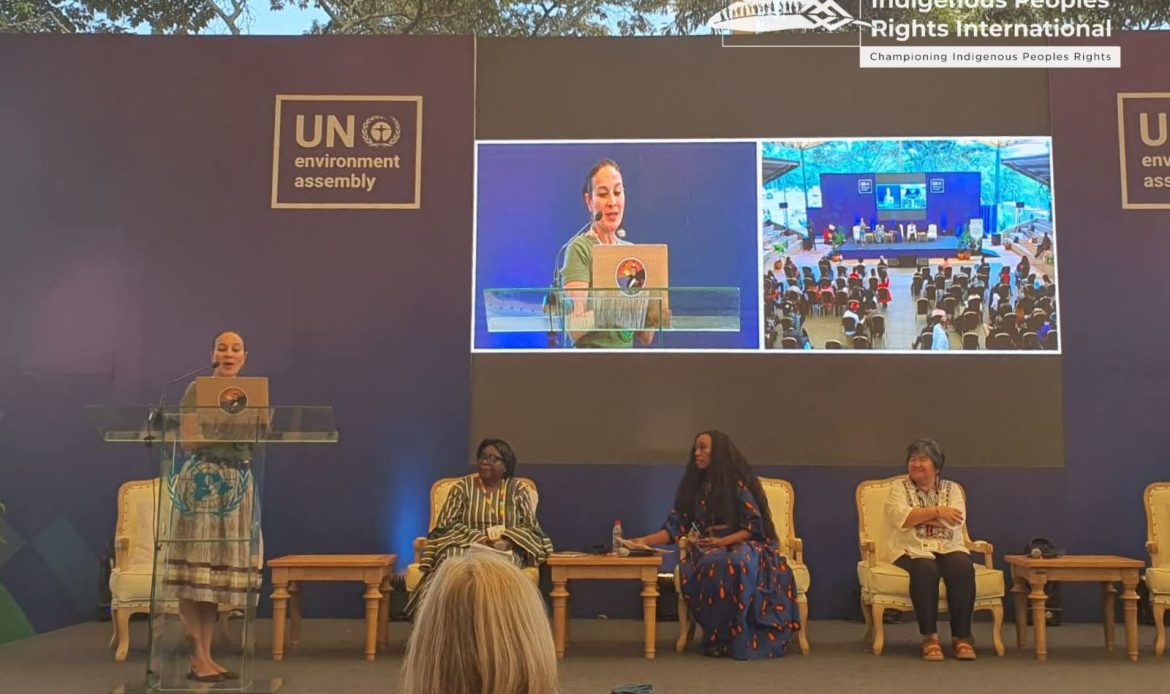
At the UNEA Special Dialogue on 08 December 2025 on the Role of Indigenous Peoples and Their Communities in Advancing Sustainable Solutions for a Resilient Planet, IPRI executive director Joan Carling presented three key recommendations to strengthen synergies across the three Rio Conventions — on climate change, biodiversity, and desertification — toward a truly just and resilient future.
The following were emphasized as urgent priorities for protecting Indigenous environment defenders:
1. High-level commitment across all conventions
“There must be zero tolerance for the criminalization of Indigenous Peoples when we protect nature,” Carling stressed.
All three global environmental conventions must adopt a clear, high-level commitment recognizing Indigenous Peoples as rights holders, knowledge bearers, and stewards of nature. This commitment must condemn attacks against Indigenous environment defenders, ensure their meaningful and safe participation — including at COPs and UN processes — and affirm that Indigenous Peoples are valued partners, not obstacles, in achieving environmental goals.
2. Align national plans with Indigenous rights and environment protection
“We cannot claim to protect the environment while authorizing policies that destroy it,” according to Carling.
National plans and strategies must be aligned to avoid contradictions — for example, pledging conservation while opening Indigenous territories to mining for transition minerals. Policy coherence requires placing Indigenous rights and environmental protection at the center, not at the margins, of national action.
3. Create a joint monitoring and reporting system on Indigenous Peoples’ rights
“We monitor carbon and restored forests — but not the Indigenous defenders who are killed, jailed, or criminalized,” Carling lamented.
A unified monitoring and reporting mechanism must track killings, arbitrary arrests, detentions, and criminalization of Indigenous Peoples. States must ensure access to justice, redress mechanisms, and accountability measures to stop impunity and protect environment defenders.
As Human Rights Day meets UNEA, one principle must guide global action: the planet cannot be protected by attacking its protectors. – IPRI
