
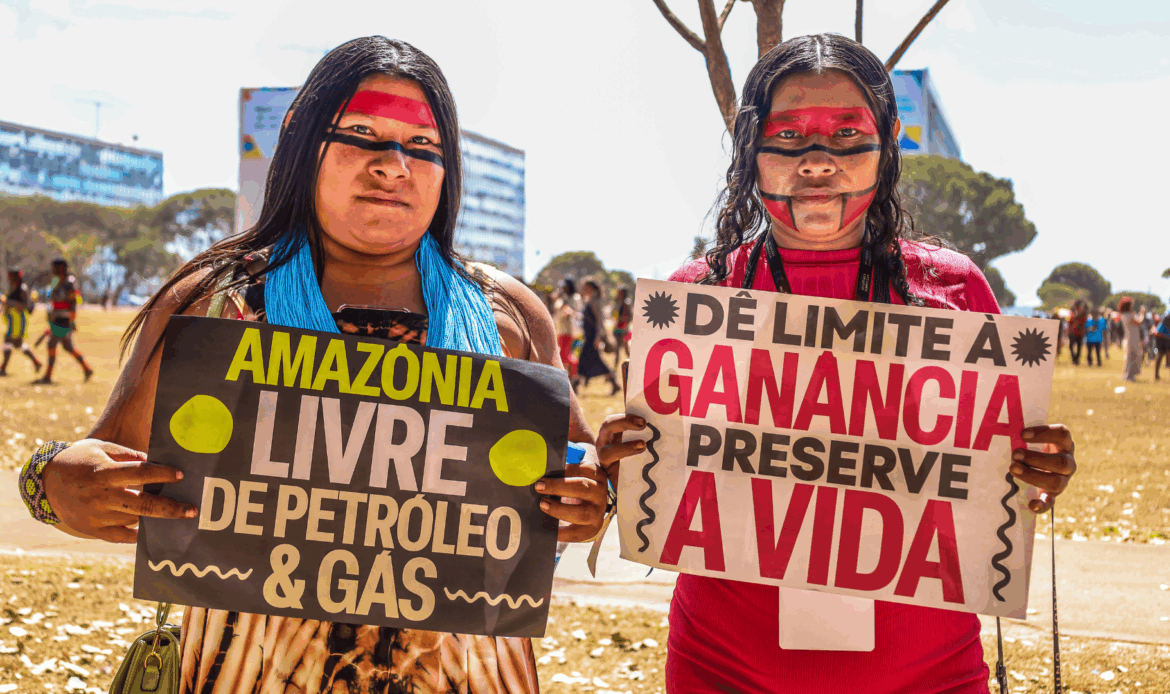
More than 3,500 Indigenous delegates, from the Amazon and across the world, are expected to gather in Belém to assert that Indigenous leadership is indispensable to the planet’s survival.
Situated at the mouth of the Amazon River, Belém stands as both a gateway to the world’s largest rainforest and a living testament to centuries of Indigenous stewardship. Brazil’s decision to host COP30, which it has dubbed the “Indigenous COP,” carries profound symbolic weight. It signals recognition that the Amazon, and the global climate it sustains, cannot survive without protecting Indigenous territories and upholding Indigenous rights.
At this intersection of climate ambition and political reality, the decisions made in Belém could shape the future of both Indigenous lands and the planet itself. The Amazon, long called the lungs of the Earth, is more than a setting for negotiations; it is the front line of a crisis where the promises of a “just transition” continue to clash with enduring patterns of exploitation.
As governments negotiate emissions targets and climate finance, Indigenous Peoples bring a clear warning: without secure land rights, every climate goal remains on fragile ground.
The Numbers Behind the Narrative
Indigenous Peoples manage about one-quarter of the planet’s surface. According to the Intergovernmental Panel on Climate Change (2022), recognizing Indigenous land tenure is one of the most effective and equitable ways to mitigate and adapt to climate change. Forests under Indigenous management in the Amazon store nearly one-third of the basin’s carbon, serving as a critical defense against rising global temperatures (Walker et al., PNAS, 2020).
Despite this, over half of Indigenous and community lands remain legally unrecognized worldwide (RRI, 2021). This lack of recognition leaves millions of hectares exposed to encroachment by extractive industries, agribusiness, and large-scale renewable energy projects carried out without Free, Prior, and Informed Consent (FPIC).
This reality reveals a striking paradox: those who safeguard the Earth’s ecosystems are the most threatened by the solutions proposed to address the climate crisis.
As nations rush to decarbonize, Indigenous territories are emerging as the next frontiers of extraction. Demand for “transition minerals” – like lithium, nickel, and cobalt – is surging, with more than half of known reserves overlapping with Indigenous lands (World Bank, 2022). The International Energy Agency (2023) projects that global demand for these minerals will quadruple by 2040. Across regions such as the Andes, Indonesia, and the Philippines, new mining projects are igniting land conflicts and deepening social divisions.
Similarly, renewable energy projects promoted under the banner of “green growth” are replicating the same extractive models of the fossil fuel era. The Indigenous Peoples’ Rights International’s (IPRI) documentation on criminalization and attacks on Indigenous defenders documents a rising number of violations linked to such projects from geothermal sites in Indonesia to hydropower developments in the Philippines.
If the global energy transition continues to depend on the dispossession of Indigenous Peoples, it will not be just. It will merely reinvent colonialism in green terms.
Defending the Defenders
The climate crisis is not only environmental; it is deeply human. In 2023, nearly 80% of all killings of environmental defenders occurred in Latin America, most of them Indigenous (Global Witness, 2024). The Amazon remains the deadliest region for those protecting forests and rivers from illegal logging, mining, and agribusiness expansion.
At COP30, IPRI and allied groups aim to bring these defenders’ stories to the forefront of the global climate conversation. Indigenous women, youth, and community leaders will press negotiators to integrate mechanisms for the protection of land and environmental defenders into climate and energy policies.
Land Rights as Climate Policy
What is at stake in Belém extends beyond recognition; it is a test of whether global climate policy can finally shift from extraction to equity. International frameworks, from the Kunming–Montreal Global Biodiversity Framework to the UNFCCC’s Just Transition Work Programme, have acknowledged Indigenous Peoples’ essential role. Yet these commitments remain hollow as long as land tenure, the basis of Indigenous governance, remains insecure.
Evidence is unequivocal: when Indigenous territories are legally protected, deforestation drops, biodiversity flourishes, and communities strengthen their resilience to climate shocks. Recognizing land rights is not charity or token inclusion; it is an evidence-based climate strategy rooted in justice and sustainability.
What COP30 Must Deliver
As the world turns its eyes to Belém, Indigenous Peoples and their allies are calling for:
- Legal recognition and protection of Indigenous territories, aligned with the Paris Agreement and Global Biodiversity Framework;
- Binding Free, Prior, and Informed Consent (FPIC) standards in all climate and energy investments;
- Direct, flexible funding for Indigenous-led governance, conservation, and adaptation initiatives;
- Institutionalized protection mechanisms for Indigenous defenders within national and global climate frameworks.
The Moral Test of Belém
Indigenous territories safeguard over half of the world’s remaining biodiversity. They regulate carbon cycles, sustain freshwater systems, and preserve knowledge systems that offer pathways for climate resilience. Yet Indigenous communities continue to face criminalization and displacement under the guise of “development,” “conservation,” and “climate solutions.”
At COP30, Indigenous Peoples and their partners seek not only to expose these injustices but to demonstrate what genuine solutions look like: grounded in rights, consent, and the interdependence between people and nature.
The outcome in Belém will measure whether the world is ready to confront its colonial past and embrace a truly just transition — one that values protection over profit and partnership over exploitation.
For Indigenous Peoples, what is at stake is the right to live, to govern their lands, and to participate as equals in shaping the world’s response to the climate crisis.
For the rest of humanity, what is at stake is the future of a planet capable of sustaining life.
When Indigenous lands fall, the last lines of defense against climate collapse fall with them.
References:
- IPCC Sixth Assessment Report, 2022
- Rights and Resources Initiative (RRI), Tenure Rights in the Climate Crisis, 2021
- Global Witness, Defending the Defenders, 2024
- IPBES Global Assessment, 2019
- Walker, W. et al., PNAS, 2020
- International Energy Agency (IEA), Critical Minerals Market Review, 2023
- World Bank, Minerals for Climate Action, 2022
- IPRI (2025), Database on Criminalization and Attacks on Indigenous Defenders


