
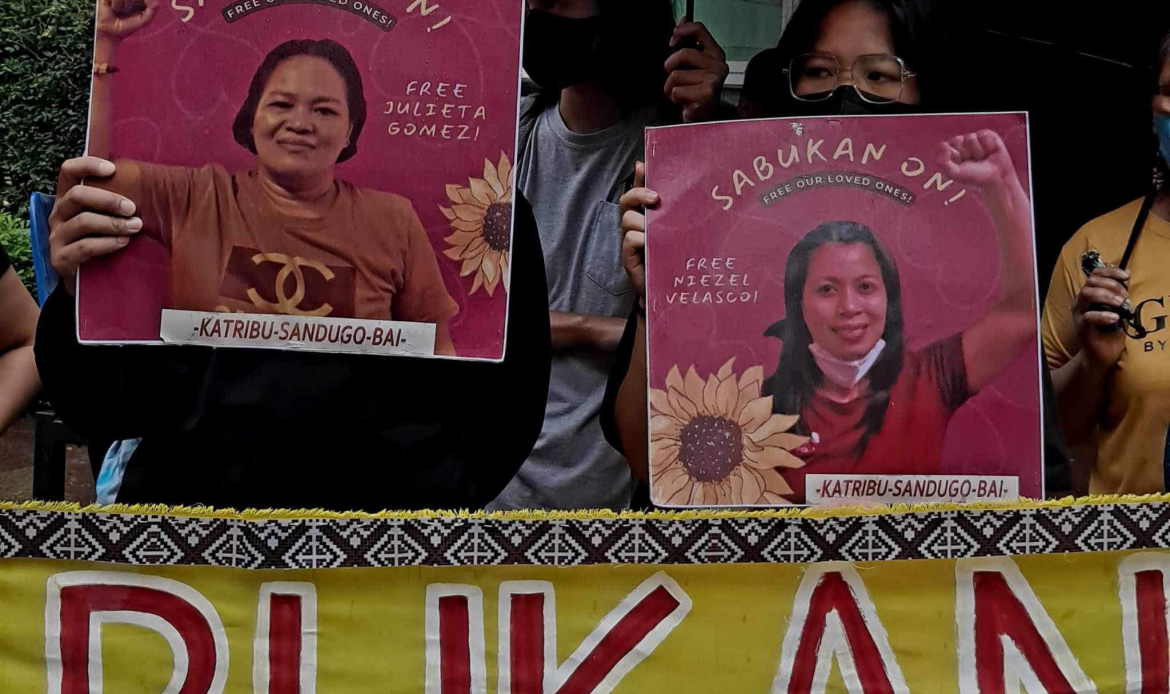
The story of Lumad-Manobo defender Julieta Gomez on International Women’s Day
Julieta Gomez spent nearly four years in detention after being accused of crimes that Philippine courts later dismissed for lack of evidence. A Lumad-Manobo Indigenous rights defender from Mindanao, her case reflects the risks Indigenous women face when they stand up to defend their land, communities, and rights.
As the world marks International Women’s Day, Gomez’s story highlights both the vulnerability and resilience of Indigenous women human rights defenders in the Philippines.
Born in San Luis, Agusan del Sur, Gomez has long been involved in campaigns defending Lumad ancestral lands in the Caraga region of Mindanao. A member of the Indigenous peoples’ organization Kahugpungan sa mga Lumadnong Organisasyon sa Caraga (Kasalo-Caraga), she has spoken out against militarization and large-scale mining projects affecting Indigenous territories.
Like many Indigenous women defenders, Gomez’s advocacy has exposed her to significant risks. Indigenous women defending their lands and territories frequently face threats and violence, red-tagging, arbitrary detention, and criminalization.
Her advocacy dates back more than a decade. In 2010, Gomez joined campaigns exposing the inequitable distribution of mining profits and royalties from projects operating in Lumad territories. In 2015, she helped lead the nationwide caravan known as the Manilakbayan, traveling with other Indigenous leaders and supporters to Manila to raise awareness about human rights violations linked to mining and plantation expansion in Mindanao.
Her activism took a dramatic turn in July 2021, when authorities arrested Gomez in Quezon City along with another Indigenous rights activist. Both were charged with murder and attempted murder. Courts later dismissed the charges in 2022 and 2023 for lack of evidence.
Gomez also faced accusations of illegal possession of firearms and explosives. After years of legal proceedings, a court acquitted her of these charges on April 8, 2025, ending nearly four years of arbitrary detention.
Despite her acquittal, Gomez’s situation reflects the continuing risks faced by Indigenous rights defenders in the Philippines. Activists frequently report intimidation, surveillance, red-tagging, and fear of reprisals for their advocacy.
The country remains one of the global hotspots for the criminalization of Indigenous defenders, particularly since the introduction of the Anti-Terrorism Law (ATL) in 2020. The law allows authorities to make arrests without warrants and expand surveillance powers, raising concerns among human rights organizations about its potential use against activists.
Across Asia, the pattern is widespread. According to Global Witness, more than 341 cases of detention or arrest of land and environmental defenders were recorded in the region between 2018 and 2024, including in Indonesia, India, Vietnam, and the Philippines.
Although most arrests involve men, the detention of Indigenous defenders often places additional burdens on families and communities, where women frequently assume expanded leadership and caregiving roles.
Data from Indigenous Peoples Rights International also reflects this trend. In 2025, the organization received 51 case submissions from Indigenous communities across Asia, including 19 cases affecting Indigenous women.
Gomez’s experience underscores the broader challenges faced by Indigenous women defenders, who often stand at the forefront of efforts to protect land, culture, and community.
As International Women’s Day draws attention to women’s rights and gender equality worldwide, her story serves as a reminder of both the resilience of Indigenous women defenders and the continuing need for protection and justice.
Photo: Katribu Youth


