
From commitments to reality: why Indigenous consent is still failing in global investment projects
Washington, D.C., April 14, 2026 — Despite years of policy commitments, the gap between recognizing Indigenous Peoples’ rights and actually respecting them on the ground remains wide.
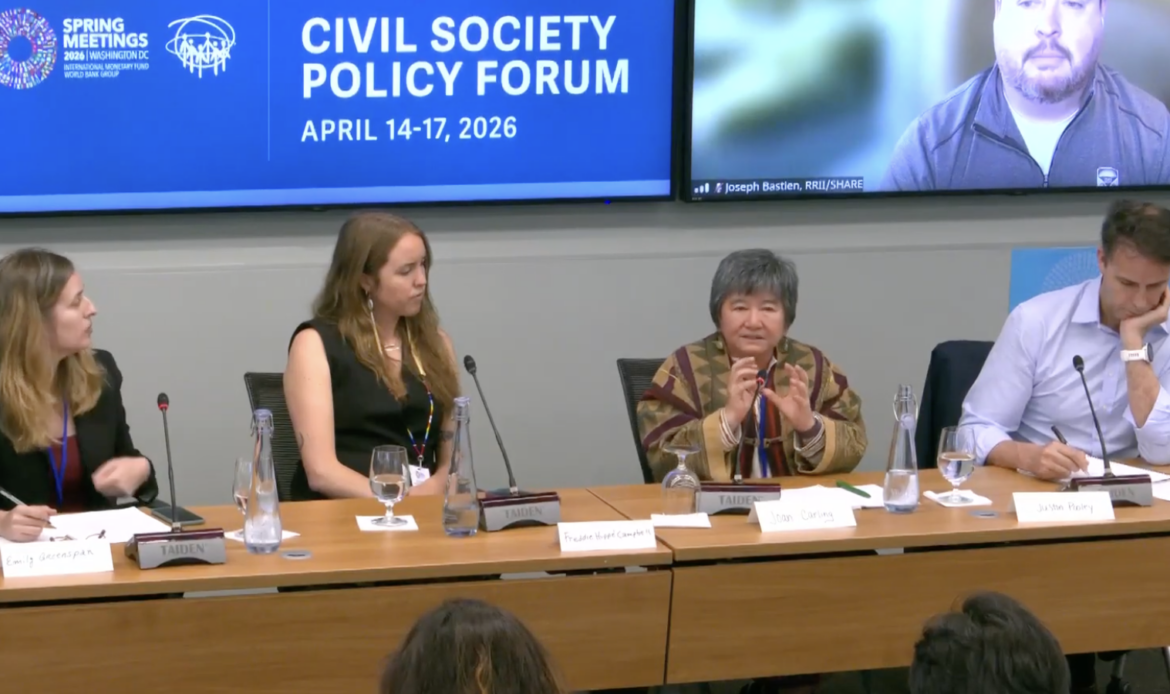
That was the central message at a high-level session during the World Bank Group Spring Meetings, where Indigenous leaders, investors, and development actors confronted a persistent question: why does Free, Prior and Informed Consent (FPIC) still break down in practice?
Bringing together voices from Indigenous organizations, the private sector, and finance institutions, the discussion exposed a pattern that cuts across sectors — from renewable energy to mining and infrastructure: projects fail not because FPIC is unclear, but because it is ignored, diluted, or manipulated.
“Companies are still not showing up in the right way,” said Freddie Huppé Campbell, Director of the Energy & Climate team at Indigenous Clean Energy, a Michif Two-Spirit leader working to advance community-led clean energy sovereignty and equitable climate action.
When that happens, projects stall, face conflict, or collapse altogether.
But the inverse is also true. Where FPIC is respected as a process, not a checkbox, projects are more likely to succeed. Campbell pointed to evidence from Canada, where Indigenous Nations are rapidly becoming key actors in the energy transition. According to data from Indigenous Clean Energy and the Canada Energy Regulator, Indigenous Peoples hold stakes in approximately 20% of the country’s electricity-generating infrastructure — a figure that reflects a growing shift toward equity partnerships and shared ownership.
Examples such as the Solar North Project in Haida Gwaii and the Inuvik High Point Wind project in the Northwest Territories illustrate how Indigenous-led or co-developed initiatives can deliver both energy and long-term community benefits.
Yet even in countries with strong legal frameworks, implementation gaps persist.
Joan Carling, Executive Director of Indigenous Peoples Rights International (IPRI) and a globally recognized Indigenous leader with over three decades of advocacy on human rights, climate justice, and environmental protection, warned of what she described as “engineered consent”, that is, practices where companies or local authorities bypass legitimate Indigenous leadership to secure approval.
“These are not isolated incidents,” she noted, pointing to cases in the Philippines, where FPIC is legally mandated under the Indigenous Peoples’ Rights Act of 1997, yet routinely undermined in practice through manipulation of leadership structures or failure to deliver promised benefits such as jobs, scholarships, and infrastructure.
At stake is more than procedural compliance. FPIC, Carling stressed, is not a one-time approval but an ongoing process grounded in Indigenous governance systems and defined by communities themselves.
For investors, these failures are not just ethical concerns but also financially material risks.
Joseph Bastien, Anishinaabe from Wiikwemkoong Unceded Territory and Associate Director for Inclusive Economy at SHARE Canada, emphasized that weak FPIC processes can trigger legal disputes, reputational damage, and costly project delays or cancellations. “Trust but verify,” he urged, calling for stronger transparency in impact-benefit agreements, standardized reporting on social performance, and caution around non-disclosure agreements that can obscure risks.
To address these gaps, Bastien pointed to emerging tools for investors, including the “Respecting Indigenous Rights: An Actionable Due Diligence Toolkit for Institutional Investors,” developed by Indigenous leaders and experts to guide rights-based investment practices.
The discussion also highlighted deeper structural challenges. Global standards remain inconsistent, particularly in how FPIC is defined and applied across frameworks such as the Consolidated Mining Standard, creating uneven expectations and enforcement. At the same time, companies are facing growing scrutiny for how they implement these standards both domestically and abroad — with direct implications for investor confidence.
A critical issue raised throughout the session was the need to recognize Indigenous Peoples as rights holders, not merely stakeholders, a distinction that fundamentally reshapes power dynamics in negotiations and the scope of corporate obligations.
For the World Bank Group, the challenge ahead lies in translating evolving standards into consistent practice.
Justin Pooley, Manager for Environmental & Social Policy and Knowledge at the World Bank Group, underscored the importance of strengthening collaboration with Indigenous Peoples and advancing policy development, training, and capacity-building efforts across public and private sector operations — including ongoing work to review and update the IFC/MIGA Environmental and Social Sustainability Framework.
Across perspectives, one conclusion stood out: stronger policies alone will not close the gap.
Respecting Indigenous consent requires sustained engagement, real accountability, and a shift in how power is shared in development processes. Until then, FPIC risks remaining a promise on paper, rather than a guarantee in practice.


