
Date: April 22, 2026, Time: 15:00-16:15pm
Venue: CR-9, UN Headquarters
Language Spoken by Speakers: French, English, Spanish
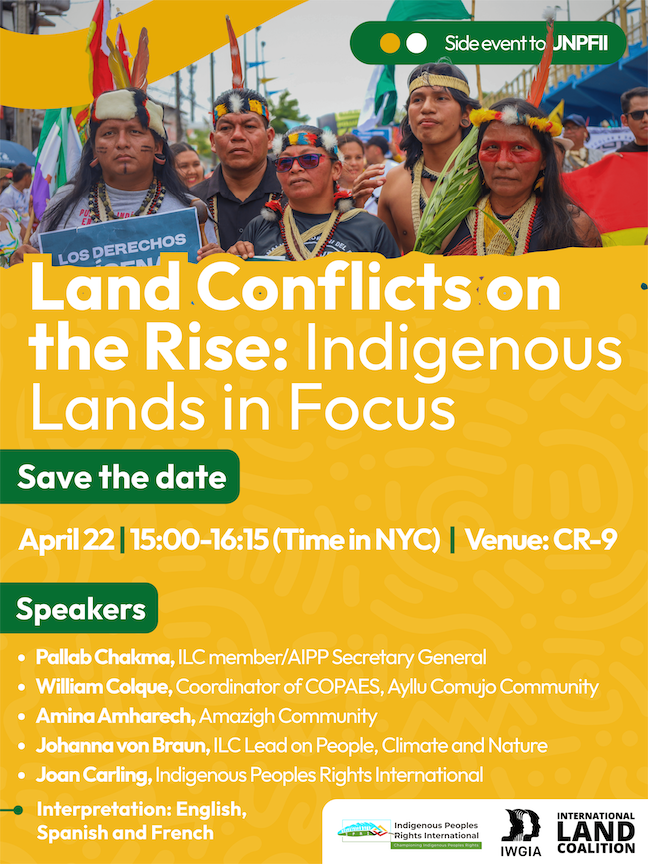
Land and territories are fundamental to the existence, collective survival and development, culture, and spirituality of Indigenous Peoples, constituting the basis of their food systems and sustainable economies and distinct identities. Despite making up only 6% of the world’s population, Indigenous Peoples are vital stewards of global biodiversity and claim 20% of the global land mass as their customary lands. However, in many countries the lack of legal recognition of ancestral lands and the richness of biodiversity and minerals protected by them result in land-grabbing, forced eviction, and violent targeting of land defenders.
Despite the adoption in 2007 of the United Nations Declaration on the Rights of Indigenous Peoples (UNDRIP) and several other international and regional instruments are highlighting the fundamental importance of the ancestral rights of indigenous Peoples to their lands, the Indigenous Peoples’ land rights continue to be precarious, with land grabbing, forced evictions, and violence against Indigenous Peoples increasing by the day. As climate change impacts accelerate and solutions of climate change pressure for natural resources grows, systemic violations of Indigenous Peoples rights simultaneously fuels, rather than resolves, the climate crisis.
This side event addresses the urgent need to bridge the gap between policy and practice positioning land rights as central to ensuring social justice, protection of human rights equity, and sustainable development for all and for climate justice.
Objectives:
- Examine land-related conflicts, environmental degradation, and the human rights violations experienced by Indigenous Peoples, with a focus on gender-differentiated impacts.
- Identify conflicts’ preventive measures and actionable recommendations for policymakers to integrate land rights into development plans, climate strategies and related agenda.
Format: Moderated Panel Discussion
Organizers: International Land Coalition (ILC), IWGIA, IPRI
Duration: 1hr and 15 minutes
Agenda:
| Time | In-charge | |
| 3:00-3:05 | Welcome and Introduction of the Side Event | IWGIA |
| 3:05-3:15 | Context-Setting: Aggregate data on Indigenous Peoples and Land Conflicts driven by climate solutions. Johanna von Braun, ILC Lead on People, Climate and Nature |
ILC |
| 3:15- 3:45 | Voices from Indigenous Peoples: Lived Experiences on Land, Development and Environment -Pallab Chakma, ILC member/AIPP Secretary General- possible discussion on on-going land issues (i.e. Indigenous communities vs industrial expansion like mining, forestry etc) of Indigenous Peoples in Asia and may highlight present issue in Bangladesh -Amina Amharech, Amazigh Community- can discuss the experience of addressing land issues/dispossessions in Amazigh community and the lack of legal protection in securing land rights -William Colque, from Ayllu Comujo of Marka Sabaya in Bolivia and part of the Indigenous Peoples of the Salar de Coipasa. He can discuss on their efforts in defending their territories from extractive industries |
|
| 3:45- 3:55 | The Path Forward: Approaches to Resolving Land Conflicts | Joan Carling, Executive Director, IPRI |
| 3:55-4:10 | Interactive: Q and A | |
| 4:10-415 | Closing Remarks/Statements |


