
Photo: Floresa Kritis Independen
At first glance, the energy transition sounds like a universal good: the world finally moving away from fossil fuels. Dams rise from rivers, solar parks spread across deserts, wind farms carve the horizon, and mines bore into mountains to extract transition minerals — all in pursuit of a cleaner, greener future.
But as the mini documentary Unjust Energy Transition reveals, the story on the ground is far more complicated. Produced by Indigenous Peoples Rights International (IPRI) and Lyf, the mini documentary journeys across the Philippines and Indonesia to uncover what happens when the global race toward “green energy” collides with Indigenous Peoples’ lands.
It is, at its core, a story about power, not just the kind that lights homes and fuels economies, but the kind that decides whose voices matter and whose lands are expendable. The mini documentary reveals how the race to decarbonize the planet is reshaping old power relationships, transferring not only energy but also control.
The unseen costs of the transition
“The energy transition that is happening now is going the wrong way,” according to Joan Carling, executive director of IPRI. Her words, featured in the mini documentary, cut through the optimism surrounding renewables.
“It is actually green colonization, the same companies from fossil fuels shifting to renewables, still driven by profit more than by the needs of people or the climate,” the 2024 Right Livelihood laureate warned.
Unjust Energy Transition frames this global shift not as a purely environmental or economic issue but as a moral one. What is being called “clean” energy is creating new frontiers of land grabbing, from the lithium plains of South America to the nickel mountains of Southeast Asia. Beneath the language of sustainability lies a familiar pattern: extraction without consent and development without justice.
Palawan: When green turns red
One of the mini documentary’s key stories unfolds in Palawan, the Philippines’ last ecological frontier. Here, the promise of clean energy has stained the land in literal ways. In 2023, heavy rains turned rice paddies crimson with laterite mud from nearby nickel mines, which extract minerals used for electric cars and solar technologies.
“Mining and farming can’t go together,” said indigenous farmer Norman Bueno, standing beside the damaged fields of his community.
“Laterite mining ruins our water, fields, and coconut lands,” he added.
The Pal’wan people’s story captures the contradictions of the global transition: communities asked to sacrifice their food, water, and way of life so that others may drive emission-free vehicles. What the world calls progress, they experience as dispossession.
Poco Leok: Displacement in the name of energy transition
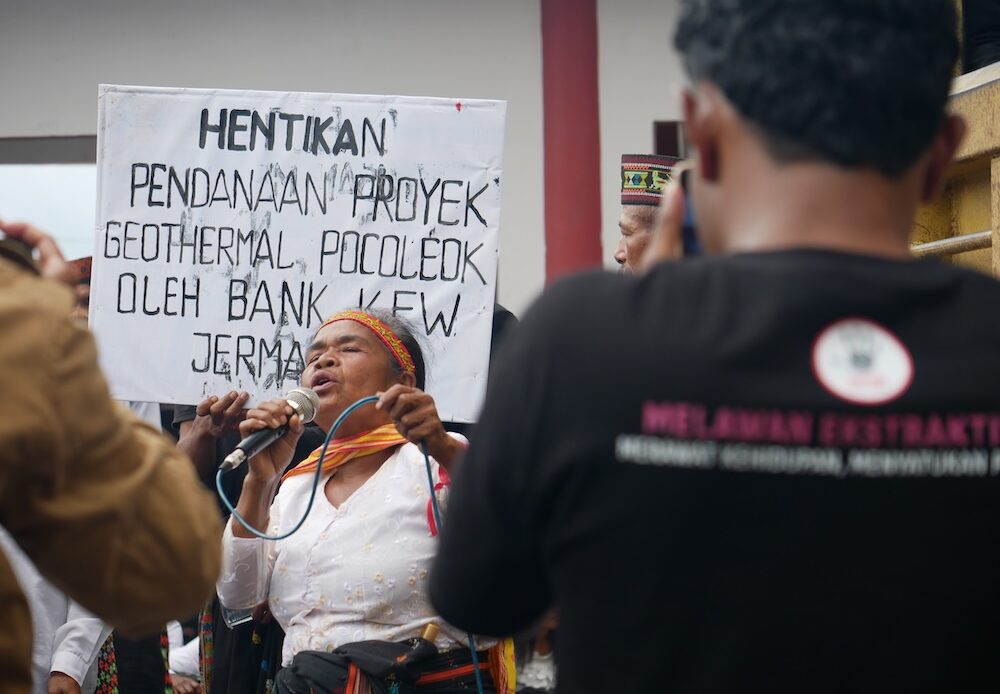
From the forests of Palawan, Unjust Energy Transition moves to the volcanic highlands of Flores, Indonesia, another front in the same struggle. In Poco Leok, a state-owned utility backed by a German bank is developing a massive geothermal project. The company claims it is for the public good. But the local Indigenous communities say it was imposed without their Free, Prior, and Informed Consent (FPIC), a right recognized under international law.
“The project threatens our forests, farms, and sacred grounds,” shared Kristianus Jaret of the Indigenous Peoples Alliance of the Archipelago. His voice in the mini documentary is steady, but the images around him — soldiers, patrols, protest banners — tell a different story.
For these communities, the energy transition has brought not empowerment but displacement. Yet their resistance, rooted in unity, has made ripples. After local and international pressure, the bank suspended its funding. It was a small victory, but one that proved collective action can still shift the current.
Numbers that tell inhumane stories
Since 2021, IPRI has tracked nearly 500 cases of violence and harassment against Indigenous peoples in Asia, ranging from arrests to killings. Twenty-four of these cases, as the mini documentary visualizes through animated maps and data, are linked directly to energy transition projects, affecting almost 100,000 Indigenous women, men, and children.
Eighteen are tied to hydropower dams in the Philippines, India, and Nepal. These projects divert rivers in the name of clean energy but often leave the communities at their source literally in the dark.
Each data point represents a life disrupted: a farmer, a forest guard, a child forced to move. The energy transition is global, but its consequences are deeply local.
Apayao: Power that empowers
Yet Unjust Energy Transition also highlights a different kind of story, one that shows what a truly just energy transition can look like.
High in the northern mountains of the Philippines, the Isneg people of Apayao have built four micro-hydropower systems by hand, without corporate contracts or government control. The electricity they produce powers schools, homes, and livelihoods, sustained by the same river that sustains them.
“When we got electricity, everything changed,” said community leader Rodolfo Sagban, chair of the Lapat Microhydro Power Association.
“Life became easier. We’re grateful for our micro-hydro,” he shared.
For the Isneg indigenous peoples, renewable energy is not a commodity. It is a community project. When nearby villages asked for help, Sagban and his team offered to teach them.
“The key is management,” he stressed, adding that “we share what we know so others can build their own.” This is what self-determination looks like: a clean energy model powered by the people it serves.
A Borderless exchange of wisdom
The mini documentary then travels to West Kalimantan, Indonesia, where Indigenous communities in Tadungus learned from their peers in Sabah, Malaysia. By sharing Indigenous knowledge across borders, they built their own renewable energy system — small, local, and sustainable.
In Tadungus, the forest remains intact. The culture endures. The lights stay on. This, Unjust Energy Transition suggests, is the kind of energy transition the world needs — one rooted not in exploitation but in reciprocity.
Redefining collaboration
“The big difference with Indigenous leadership,” Carling said in the mini documentary’s closing sequence, “is that we have the right values. We see nature as part of us. We only take what we need and care for it so that it cares for us.”
Her words form the moral center of Unjust Energy Transition. The mini documentary is not only a chronicle of loss but a challenge to rethink what progress means and who gets to define it.
What is happening in Palawan and Apayao, in Poco Leok and Tadungus, is not only about energy. It is about power: who controls it, who benefits from it, and who must fight for it.
Across continents, Indigenous peoples are showing that the path to a sustainable future does not have to be paved with displacement. When they lead, the transition becomes something else entirely, not a rush for resources, but a movement for justice.
If the world is serious about confronting the climate crisis, the message of Unjust Energy Transition is clear and urgent: Build the energy transition in partnership with Indigenous peoples. They have protected the Earth for generations, and they hold the wisdom to help save it.


