
Argentina: The Less It Protects Glaciers, the Greater the Legal Risk
Summary: Argentina’s 2026 glacier reform weakens protections for glaciers and periglacial environments, triggering legal challenges and concerns over Indigenous Peoples’ rights, lithium mining expansion, water security, and compliance with international environmental law. The reform has intensified debates over environmental non-regression, federal governance, and the risks of extractive projects in sensitive ecosystems such as Salinas Grandes and Laguna de Guayatayoc.
By Soledad Sede
Argentina’s Glacier Law did not emerge in a vacuum. The first attempt to regulate glacier protection, passed in 2008, was vetoed by the Executive amid strong pressure from the mining sector. Two years later, Congress enacted Law 26.639, establishing minimum environmental standards to protect glaciers and the periglacial environment as strategic water reserves. Crucially, the law mandated the creation of a National Glacier Inventory to identify and monitor these ecosystems across the country, assigning this task to the Instituto Argentino de Nivología, Glaciología y Ciencias Ambientales (IANIGLA). At its core, the law reflected a broader question: how far can extractive development advance in territories where water is both scarce and essential?
That question quickly reached the courts. Mining companies and the Province of San Juan challenged the law, arguing it interfered with provincial powers and economic activity. In 2019, the Corte Suprema de Justicia de la Nación, in “Barrick Exploraciones Argentinas S.A. y otro c/ Estado Nacional” (Fallos: 342:917), upheld its constitutionality. The Court confirmed that the federal government has the authority to set minimum environmental standards under Article 41 of the Constitution, establishing a nationwide baseline of protection.
This institutional design is central to understanding the current dispute. Argentina’s federal system grants Congressthe power to enact “minimum standards” for environmental protection, while provinces retain authority over natural resources within their territories. However, this autonomy is not absolute: provinces may complement or strengthen federal standards, but they cannot reduce them. The Glacier Law thus operates as a regulatory floor, ensuring a uniform level of environmental protection across the country.
This framework is reinforced by a core principle of environmental law: non-regression. Once a certain level of environmental protection has been established, it cannot be rolled back without strong justification. Closely linked to progressivity, this principle requires that environmental standards move forward, not backward. In this sense, the 2010 Glacier Law set not only a baseline, but a threshold that subsequent reforms are expected to maintain or strengthen, rather than reduce.
Key Changes to Glacier Legislation and its relation to Indigenous Peoples
Eighteen years after the first veto, however, the debate has come full circle. In 2026, the National Executive promoted a reform—enacted as Law 27.804—that narrows the scope of protection and increases provincial discretion. At the center of this shift lies the periglacial environment, historically the most contested area due to its overlap with mining interests. Provincial governments such as Santa Cruz (in southern Patagonia) and La Pampa (in central Argentina), alongside universities and civil society organizations, have interpreted the reform as a rollback of environmental protections, potentially at odds with the principle of non-regression as reflected in international environmental law, including the Escazú Agreement, the American Convention on Human Rights as interpreted by the Inter-American Court of Human Rights (Advisory Opinions OC-23/17 and OC-32/25), and broader environmental law doctrine.
The legislative process itself raised additional concerns. A public hearing held in Congress—after the bill had already obtained partial approval—registered more than 100,000 participants, yet fewer than 400 were able to speak. This exclusion of over 99% of registered participants raised serious questions about the effectiveness and legitimacy of the participatory process. Moreover, no prior consultation was carried out with Indigenous peoples, despite the fact that the reform directly affects territories where many glacier and periglacial systems are located. Under international standards, including ILO Convention 169 and the United Nations Declaration on the Rights of Indigenous Peoples (UNDRIP), such consultation is required when legislative measures may affect Indigenous communities, their territories, and their ways of life.
Unsurprisingly, the reform has triggered litigation across jurisdictions. On April 24, 2026, the Federal Court of Río Gallegos, in the Province of Santa Cruz, granted an injunction suspending the reform’s effects within the province, citing the risk of irreparable harm to glacier ecosystems (Juzgado Federal de Río Gallegos, “Honorable Concejo Deliberante de El Calafate y otros c/ Estado Nacional s/ amparo ambiental”, Expte. 5187/2026). Days later, on April 28, 2026, the Federal Court of Santa Rosa, in La Pampa, admitted a collective action brought by the provincial government, a national university, and civil society organizations, ordering its registration and advancing a constitutional challenge to the reform (Expte. 4471/2026).
Case Study: Salinas Grandes and Laguna de Guayatayoc
The case of Salinas Grandes illustrates how these legal and regulatory shifts translate on the ground. As shown in Figure 1, lithium projects—at various stages of development—overlap with Indigenous territories and environmentally sensitive areas, including glacier zones identified by IANIGLA through the National Glacier Inventory. This spatial convergence reflects a broader pattern of extractive expansion into fragile ecosystems that play a critical role in water regulation.
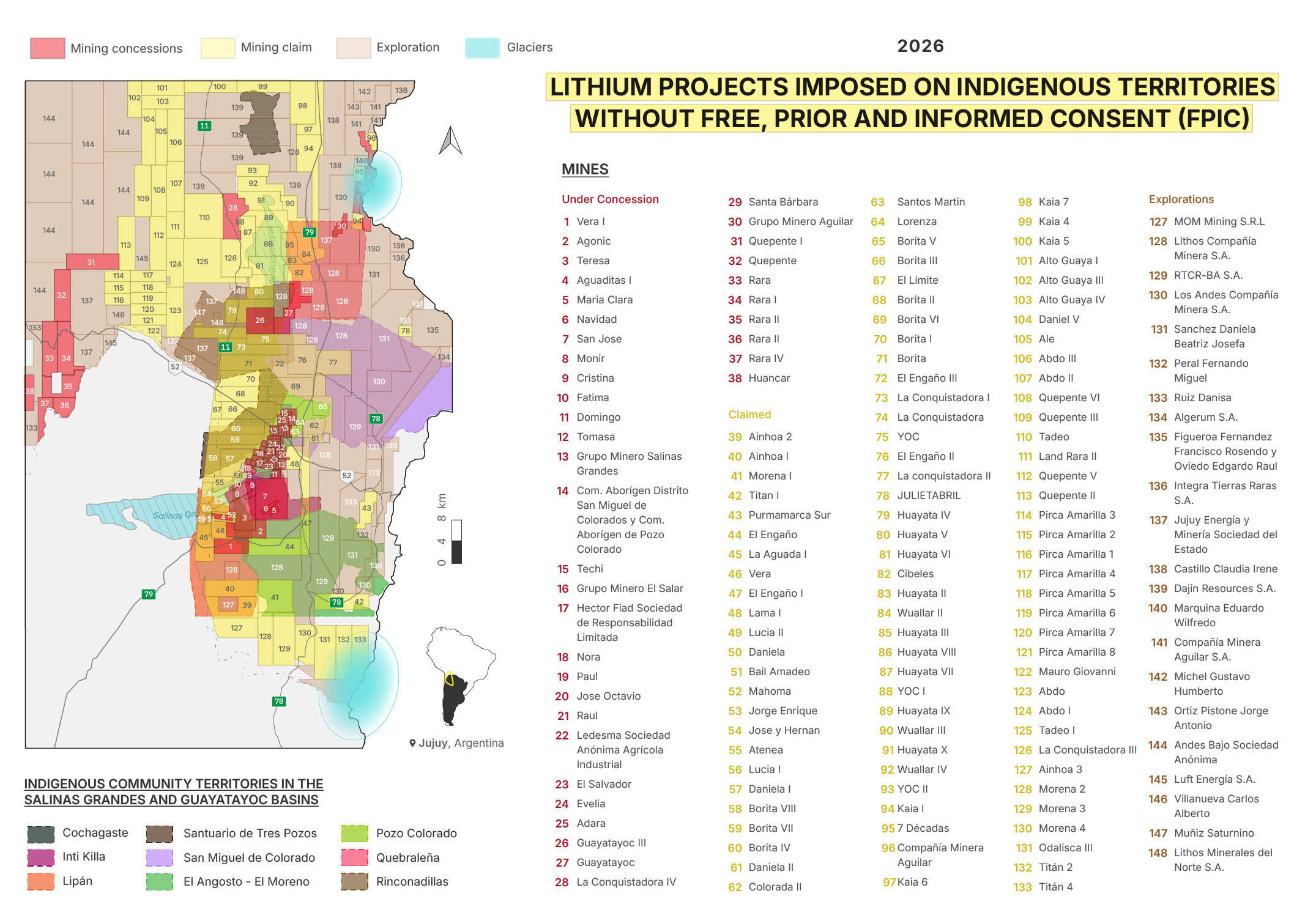
In such contexts, the weakening of glacier protection is not merely a legal adjustment. In Salinas Grandes, where water sustains both ecosystems and the livelihoods of more than 50 Indigenous communities, reduced safeguards may intensify pre-existing socio-environmental tensions and lead to cumulative and potentially irreversible impacts.
From a policy perspective, the reform was framed as a tool to provide certainty and attract investment. Yet, early developments suggest the opposite dynamic: increased litigation, fragmented judicial responses, and growing legal uncertainty. By lowering the effective environmental baseline—potentially in tension with international commitments—Argentina’s glacier reform raises broader questions about regulatory coherence, federal governance, and the management of strategic resources in the context of the global energy transition.


