
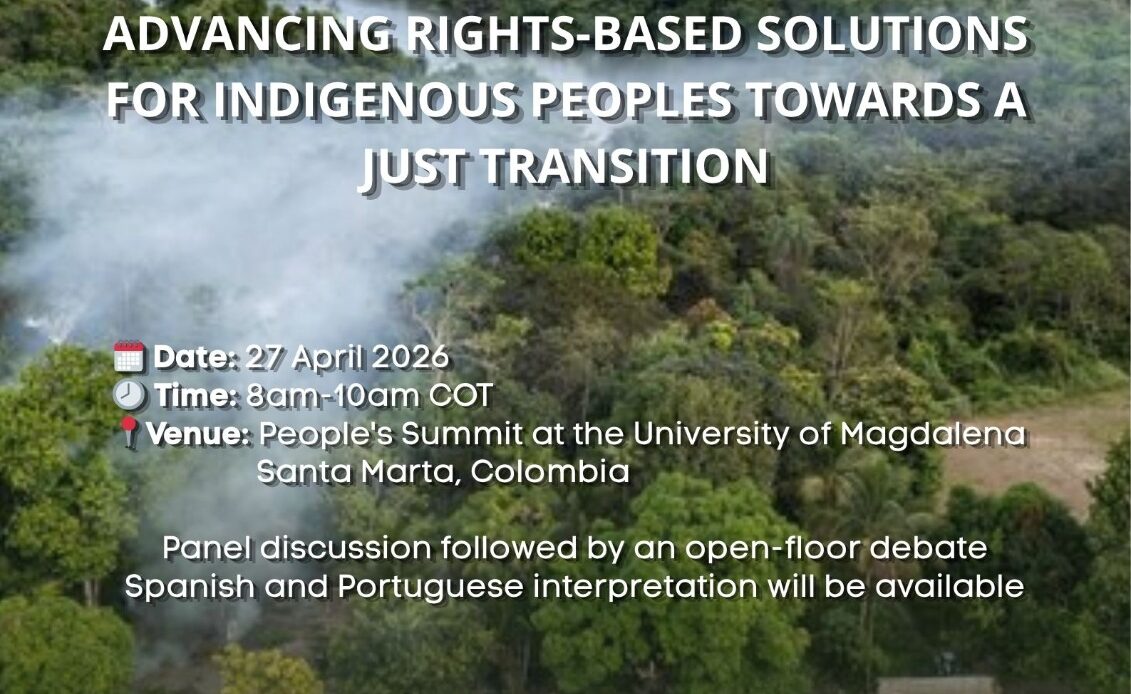
Side Event
Confronting Barriers and Advancing Rights-Based Solutions for Indigenous Peoples Towards a Just Transition
The First International Conference on the Transition Away from Fossil Fuels
24–29 April 2026 Santa Marta, Colombia
Organised by: Indigenous Peoples Rights International (IPRI), Business and Human Rights Centre, Global Witness
Event date: 27 April 2026, 8-10am Colombia Time
Venue: Roque Moreli Auditorium, Peoples Summit , University of Magdalena
Background and Rationale
As the world moves to transition away from fossil fuels, Indigenous Peoples stand at a critical intersection: their lands and territories hold the natural resources that both powered the old extractive economy and are now being targeted to fuel the new one. The global push for renewable energy and transition minerals risks replicating the very patterns of dispossession, exclusion, and harm that have defined centuries of extractive colonialism.
Indigenous Peoples Rights International (IPRI) submitted a formal contribution to the First International Conference on the Transition Away from Fossil Fuels, documenting seven key barriers to a just transition and nine concrete solutions grounded in the lived experiences and rights of Indigenous Peoples across the world.
This side event brings those barriers and solutions to life. Indigenous voices from Latin America and the Caribbean, Asia, and Africa to share their lived realities. Partners Global Witness and the Business & Human Rights Resource Centre (BHRC) will contribute evidence and perspectives on corporate accountability and human rights standards, enriching the dialogue with their global expertise.
The event responds to an urgent need: to ensure that the conference outcomes do not lead to the replication of historical injustices under a green banner, and that Indigenous Peoples are recognised as rights-holders and key actors, not mere stakeholders in the just energy transition.
Objectives
This side event aims to:
- Elevate the barriers Indigenous Peoples face in the transition away from fossil fuels, including structural inequalities, green extractivism, lack of FPIC, exclusion from climate finance, and violence against environmental defenders.
- Present and advocate for rights-based solutions, as outlined in the conference submission, including a Fossil Fuel Treaty, direct climate finance access, and community-led energy governance.
- Amplify the lived realities of Indigenous communities from LAC, Asia, and Africa, ensuring regional voices shape global transition policy.
- Contribute concrete recommendations from Indigenous Peoples to the conference’s final outcomes and any resulting declarations or frameworks.
Proposed Agenda
Duration: 2 Hours
| Time | Activity | Lead |
| 10:00 – 10:10 | Welcome & Opening Remarks | IPRI/ moderator |
| 10:10 – 10:35 | Keynote Presentation: Barriers and Solutions for a Just Transition — Indigenous Peoples’ Perspectives | IPRI |
| 10:35 –10:45 | Perspectives from Global Civil Society: Evidence on Human Rights Violations and Environmental Defenders | Global Witness |
| 10:45 –10:55 | Perspectives from Global Civil Society: Corporate Accountability and Human Rights Standards in the Energy Transition | BHRC |
| 10:55 – 11:35 | Panel Discussion: Lived Realities from Indigenous Peoples from Latin America & the Caribbean, Asia, and Africa | Moderated by IPRI |
| 11:35 – 11:50 | Open Floor Discussion | All Participants |
| 11:50 – 12:00 | Closing Remarks & Key Messages | IPRI / Partners |
Expected Outputs
- A clear set of recommendations from Indigenous Peoples, grounded in lived experience, to be presented and submitted into the conference’s deliberations and any resulting outcomes document.
- Increased visibility of the specific rights and justice dimensions of the fossil fuel transition among conference delegates, governments, and civil society.
- A concise summary of key messages and takeaways from the event, to be disseminated as a post-event brief.
