
Where Is the “Just” in the Just Transition? Indigenous Peoples Speak Truth at First International Conference on the Transition Away from Fossil Fuels
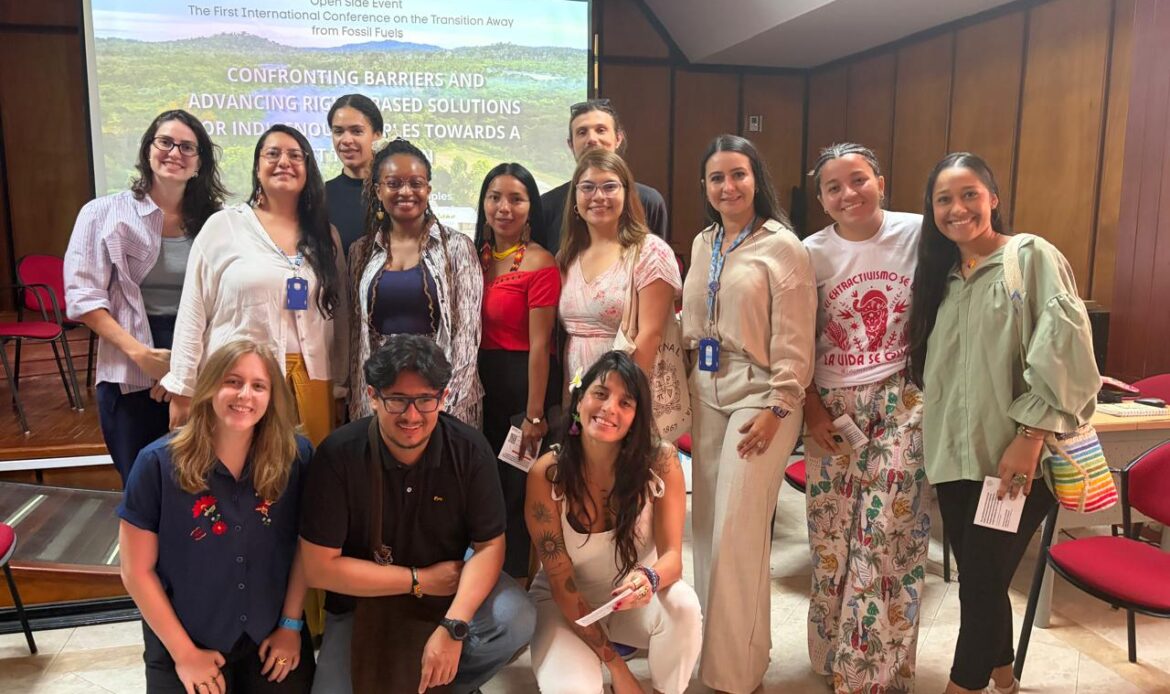
At the sidelines of the First International Conference on the Transition Away from Fossil Fuels held in Santa Marta, Colombia, Indigenous Peoples Rights International, Business and Human Rights Resource Center, and Global Witness held the side event “Confronting Barriers and Advancing Rights-Based Solutions for Indigenous Peoples Towards a Just Transition”
Just Transition or Green Colonialism?
The voices in the room came from Ecuador, Colombia, the Arctic, Africa, and beyond, and they told the same story in different languages. In the Guajira region of Colombia, coal mining by the Cerrejón company has fractured communities, eroded culture and identity, and displaced Indigenous peoples from their ancestral lands. Now, solar energy projects are arriving in the same territories, bringing new divisions. The company plays with community needs, one speaker explained. Indigenous communities are leaving their culture and identity behind. A transition is happening, but it is not theirs.
Abigail Gualinga of the Sarayaku people of Ecuador put it plainly. Before any company enters their territory, the community must be consulted, not notified, not accommodated, but genuinely asked. The Sarayaku have built a strategy to organise their community, taken their case to the highest courts, and won. Yet the pattern persists everywhere: companies arrive, governments approve, and communities are left to absorb the damage. “If Indigenous Peoples are not part of the Just Transition,” she said, “there is no justice.”
The Amazon holds 80% of the world’s biodiversity. The Sarayaku do not call those resources “natural resources”; they call them “life”. And when extractive industries describe themselves as development, Ms. Gualinga calls it what it is: an insult.
Fabian Leon of the BHRRC raised the contradiction embedded in the transition itself: all conversations center on electricity generation, yet the infrastructure built to deliver it, the deforestation, the mining, the roads, destroy the very ecosystems and communities it claims to be saving. No one asks Indigenous Peoples anything. They destroy. They pollute the water. And then they leave.
From the Arctic, a delegate described Alaska being treated as a sacrificial zone, mining companies generating conflict between financial survival and cultural continuity, using communities as labor while undermining the foundations of their way of life.
From Africa, a speaker documented mining companies entering Indigenous lands without consent across Tanzania, Nigeria, Kenya, and the DRC, causing water and air pollution linked to maternal deaths, driving land grabbing, and accelerating deforestation. In all of these regions, one truth holds: the rights of Indigenous Peoples are not being respected. Not in the fossil fuel economy. Not in the transition economy either.
Solutions from Indigenous Peoples: from an Energy Transition towards a Just Transition
The solutions proposed were not abstract. Speakers called for Free, Prior and Informed Consent at every stage, not as a box to be ticked but as a right to be upheld. They demanded direct funding to Indigenous Peoples and their institutions, recognition of Indigenous-led data and ancestral knowledge, and community-determined participation in any project affecting their territories. Carbon credit schemes, they warned, must not become the new mechanism for dispossession. The Just Transition, as currently designed, is colonial: it arrives from far away, is decided by others, and is for the benefit of others.
Indigenous Peoples Rights International came to Santa Marta to insist that it needs to put Indigenous Peoples Rights at the center of the transition away from Fossil Fuels and that it involves the very communities whose territories are being targeted to power the green economy; if their consent is bypassed, if their lands are taken for solar panels and oil wells, then the name changes, and nothing else does.
The Just Transition must break with the logic that built the fossil fuel economy, or it is not a transition at all.


