
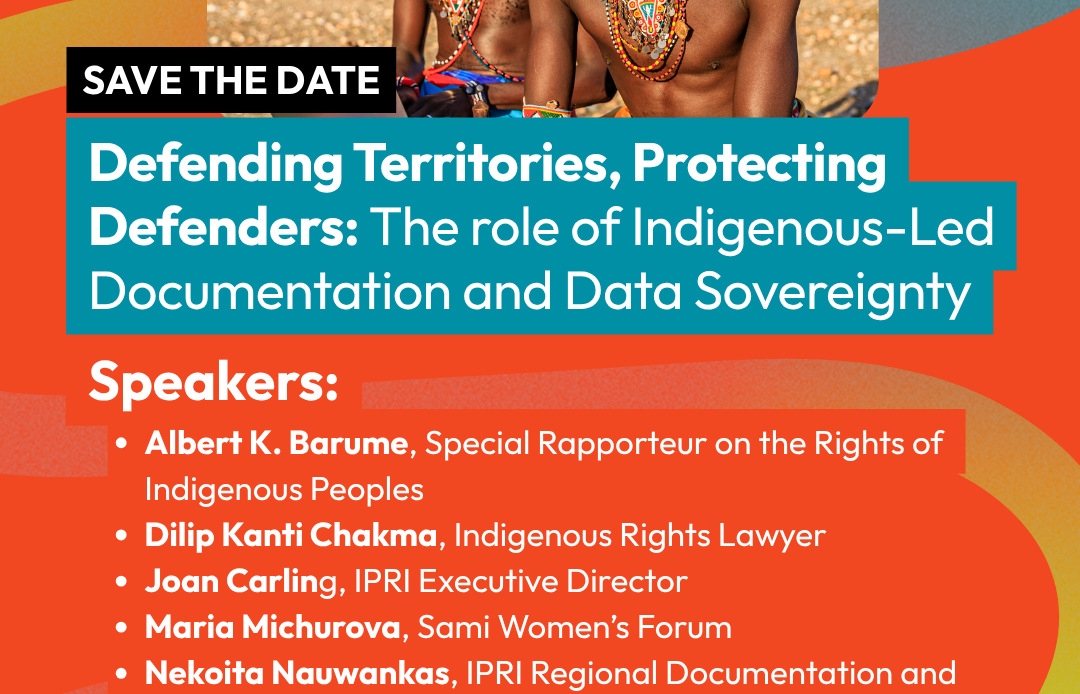
EMRIP Side Event
“Defending Territories, Protecting Defenders: The role of Indigenous-Led Documentation and Data Sovereignty”
Tuesday/Thursday, 16 July 2026, 14:00 to 15:00
Room XI
(ENG/SPA/RUS)
1. Background
Indigenous Peoples Rights International (IPRI) is an Indigenous-led international organization that works to prevent and address violence and criminalization against Indigenous Peoples that exercise or defend their human rights. IPRI works with partners in all regions of the world to document human rights violations as a basis for advocacy at the domestic, regional and global levels and supports Indigenous human rights defenders under threat.
In the report and advice EMRIP developed in 2025 on Indigenous data, it was stated that Indigenous Peoples continue to face limited control over the collection, management, ownership, and use of data concerning their territories and realities. Existing data governance frameworks frequently place decision-making power in the hands of external actors, including States, corporations, researchers, and other institutions, often without adequate safeguards, accountability, or respect for Indigenous governance systems.
In many contexts, Indigenous Peoples have also experienced “research fatigue,” where communities are repeatedly asked to contribute information and knowledge without seeing meaningful improvements, tangible benefits, or protection outcomes. At the same time, current practices around big data and open data, whether under the auspices of Governments or corporations, will likely move Indigenous Peoples’ data interests even further away from where decisions affecting Indigenous Peoples’ data are made[1].
Addressing these challenges requires a concerted effort to develop frameworks that respect Indigenous rights, promote equity and ensure that data governance aligns with Indigenous values and interests.
Therefore, IPRI would like to share with partners and experts the experiences on the ground and debate how the collection, storage and use of these data by Indigenous Peoples themselves can contribute to a stronger advocacy and protection of defenders, while sustaining a new narrative that values Indigenous Peoples’ rights and views.
2. Organizers
- Indigenous Peoples Rights International (IPRI)
- Indigenous Rights Advocacy Centre, India
3. Objectives of the side event
- Present the work of IPRI and its Indigenous partners in the documentation of violence and criminalization of Indigenous Peoples: database
- Discuss the main challenges in the collection, verification, storage and use of Indigenous data on violence and discrimination
- Showcase how data collection and documentation can serve as a tool for the defense of Indigenous Peoples’ rights by strengthening advocacy actions, community protection mechanisms, and rapid response provided through the Legal Defense and Sanctuary Fund.
4. Panelists
- IPRI executive director (importance of Indigenous-generated documentation on UN protection mechanisms in holding perpetrators accountable.)
- IPRI database and documentation team (how we work; presentation of database, documenting cases linked to LDSF etc)
- Partner on documenting cases on the ground (obstacles, risk management, etc.)
- Panel speaker from Russia
- Special Rapporteur on the Rights of Indigenous Peoples (reflections and practical advice on how the UN system can better support and respect Indigenous methodologies for data collection)
- Proposed agenda
| Time | Topic | Speakers | |
| 2:00 pm – 2:10 pm | Opening and welcoming remarks | Objective of the event and the importance of Indigenous-generated documentation for the efficacy of UN protection mechanisms—including Special Procedures and Treaty Bodies—in holding perpetrators accountable and driving systemic change | Joan Carling
IPRI Executive Director -Moderator |
| 2:10 pm – 2:20 pm | Indigenous data, sovereignty, and advocacy actions | -Presentation of IPRI’s documentation methodology and database, sharing reflections on verification processes, data sovereignty, and protection considerations when documenting cases involving Indigenous defenders, and demonstrating how collected data strengthens advocacy actions and rapid support for Indigenous human rights defenders. | Nekoita Nauwankas
IPRI Regional Documentation and Advocacy Focal Point – Africa |
| 2:20 pm – 2:30 pm | Documenting cases on the ground: community experiences | Sharing experiences on community-led documentation, consent considerations, and challenges in collecting and using data for advocacy and protection | Dilip Kanti Chakma
Executive Director, Indigenous Rights Advocacy Centre
|
| 2:30 pm – 2:40 pm | Speaker from Russia | Mariia Michurova
Sami Women`s Forum |
|
| 2:40 pm – 2:50 pm | Reflections from the UNSRRIP | Reflections and practical advice on how the UN system can better support—and respect—Indigenous methodologies for data collection and the subsequent use of this data in advocacy without compromising safety or self-determination. | Albert K. Barume
Special Rapporteur on the Rights of Indigenous Peoples
|
| 2:50 pm – 2:55 pm | 1-2 Questions (from collated list of questions) | ||
| 2:55 pm – 3:00 pm | Closing remarks | Summary of highlights and recommendations | Joan Carling |
Moderation: Joan Carling, IPRI executive director
Contact persons: Maria Manuela Sequeira (nela@iprights.org), Nekoita Nauwankas (nekoita@iprights.org)

