
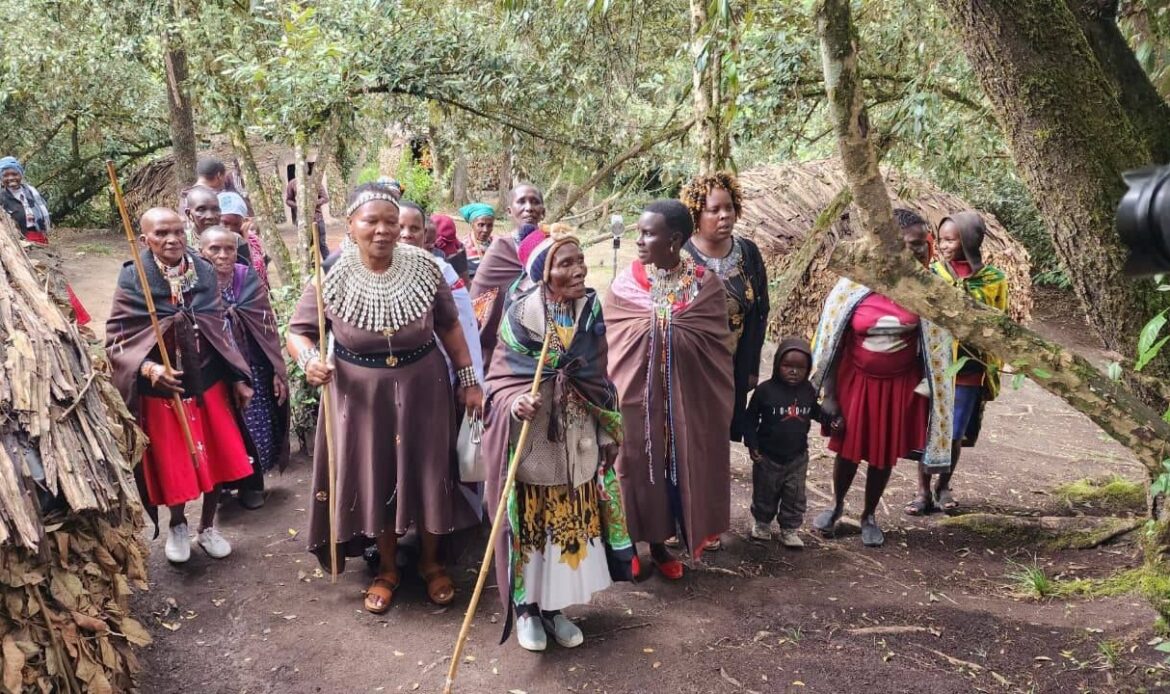
For generations, the Ogiek Indigenous Peoples have lived in Kenya’s Mau Forest Complex and in parts of Mount Elgon and the surrounding highlands, sustaining themselves through hunting, gathering, and beekeeping, and governing their territories through customary systems rooted in ecological knowledge and collective stewardship.
Today, despite a landmark court ruling recognizing their rights, many Ogiek families continue to be evicted from their ancestral lands.
“The forest is our life. My livelihood depends on this land.”
Estimated at between 20,000 and 50,000 people, the Ogiek are among the last remaining forest-dependent hunter-gatherer communities in East Africa. Their relationship with the forest is foundational to their identity, culture, spirituality, and survival. Even their name is often translated as “caretaker of all plants and animals”.
Yet this relationship has been repeatedly disrupted, not only through dispossession but also through the state’s failure to uphold binding legal decisions.
Long before state conservation regimes were imposed, the Ogiek governed their territories through customary systems, ensuring conservation through lived practice. Despite this, the Ogiek have endured decades of dispossession, criminalization, and systemic violations of their rights to land, resources, culture, religion, development, and identity.
Under British colonial rule, large portions of Ogiek ancestral territory were declared Crown Land and later gazetted as forest reserves. Their customary tenure systems were neither recognized nor protected, and even after Kenya’s independence in 1963, this historical injustice was not reversed. Instead, successive governments continued the pattern of exclusion, treating the Mau Forest as public land subject to state control and political allocation. Land traditionally managed by the Ogiek was converted into state forest reserves or allocated to private plantation companies and political elites. The Ogiek, in turn, were labelled as squatters on land they had inhabited for generations.
Evictions became normalized. Families were removed without consultation, compensation, or resettlement plans. Their homes were burned, livelihoods destroyed and confiscated, and community members were arrested for “encroachment” or “illegal grazing”. Their subsistence practices were labelled as environmental threats, even as large-scale commercial activities contributed significantly to forest degradation. The criminalization of the Ogiek presence in their ancestral lands marked a profound inversion of justice.
Custodians were turned into trespassers.
“We have lived in the forest since God created time. But now we hear people saying we do not belong to the forests, that the Ogiek do not belong here,” said Memusi Ngusilo.
By the late 2000s, evictions intensified in the name of “environmental conservation”.
In October 2009, the Kenya Forest Service issued a 30-day eviction notice to the Ogiek Indigenous families living in the Mau Forest, justifying it as a necessary action to protect water catchments and combat deforestation. Yet no meaningful consultation was undertaken with the Indigenous community, and no redress mechanism was provided.
This notice marked a turning point, as the community decided to seek justice beyond Kenya’s borders.
In November 2009, the Ogiek Peoples Development Programme (OPDP), in partnership with the Centre for Minority Rights Developments (CEMRIDE) and Minority Rights Group International (MRGI), acting on behalf of the Ogiek Indigenous community, filed a communication before the African Commission on Human and Peoples’ Rights. In 2012, the Commission referred the matter to the African Court on Human and Peoples’ Rights. In March 2013, the African Court issued provisional measures ordering Kenya to halt further evictions and refrain from actions that could cause irreparable harm pending its final judgment.
On 26 May 2017, in African Commission on Human and Peoples’ Rights v. Kenya (Application No. 006/2012), the African Court delivered a landmark decision. It unanimously held that Kenya had violated multiple provisions of the African Charter on Human and Peoples’ Rights, including: Article 2, the right to non-discrimination; Article 8, the right to religion; Article 14, the right to property; Article 17, the right to culture; Article 21, the right to natural resources; and Article 22, the right to development.
The Court recognized the Mau Forest as the Ogiek’s ancestral land and affirmed that eviction without consultation, consent, or compensation was unlawful. It rejected the state’s argument that conservation justified expulsion, emphasizing: “The preservation of the Mau Forest could not justify the lack of recognition of the Ogiek’s indigenous status or the denial of their rights”. The decision was widely celebrated as historic for Indigenous Peoples across the continent.
Unfortunately, this victory on paper did not translate into protection on the ground.
In June 2022, the African Court issued its reparations judgment, but the years between the 2017 judgment and the 2022 reparations ruling revealed the fragility of legal victories in the absence of effective implementation.
Reports documented continued forced evictions in 2018, 2019, and 2020. In July 2020, 300 Ogiek families were again forcibly removed from the Mau Forest, and in November 2023, an additional 700 community members, with homes being burned, livestock confiscated, and livelihoods disrupted. The Ogiek Indigenous Peoples continued to face arrests for “illegal occupation” and “trespass” of their customary forests. Traditional livelihood practices, including beekeeping, grazing, and accessing sacred sites, were criminalized. State agencies proceeded with enforcement operations that deepened insecurity rather than implementing the Court’s ruling.
In the reparations, the African Court ordered Kenya to: Pay approximately KES 157 million in material and moral damages; establish a community development fund; officially recognize the Ogiek as an Indigenous People; delimit, demarcate, and grant a collective title to their ancestral lands. Despite these clear directives, implementation has remained slow and incomplete.
In 2023, Ogiek elders filed Ngusilo v. Kenya (Petition No. 1 of 2023) before the Environment and Land Court in Nakuru, arguing that the state has failed to comply with both its constitutional obligations and the African Court’s decision, and on 30 May 2024, the court echoed the regional court’s findings, affirming that collective title must be granted and that eviction without due process violates constitutional and Charter rights. But implementation still remains limited.
Criminalization amid the struggle
As the Ogiek indigenous community increasingly documents violations, engages in public forums, and participates in national and international advocacy spaces, their visibility has grown. So too have the risks. Indigenous community leaders and human rights defenders report intimidation, harassment, stigmatization, and threats from state actors and state-aligned proxies. Documentation efforts, including mapping ancestral territories and collecting evidence of evictions, have drawn scrutiny. Defenders are often portrayed as anti-development or as obstacles to conservation, narratives that delegitimize their claims and heighten their vulnerability.
In response to the immediate needs of displaced Ogiek families — particularly in Tindiret Forest — the LDSF has provided support to address food insecurity, healthcare gaps, and the impacts of prolonged displacement. These interventions are part of a broader pattern in Africa, where Indigenous defenders face overlapping risks of criminalization, forced displacement, and institutional non-compliance, requiring combined legal and humanitarian responses
Justice is not only a ruling
Today, the Ogiek case stands as one of the most significant Indigenous decisions on the African continent, yet its promise remains only partially realized. Kenya’s 2010 Constitution recognizes community land and cultural rights, but the lived reality on the ground remains marked by uncertainty, occasional displacement, and continued negotiation of access to ancestral territories.
As one Ogiek community elder reflected:
We have waited for justice for decades. The Court has spoken clearly, but the government’s delays continue to harm our people and our land. We remain hopeful but demand that our rights be respected without delay.
The Ogiek Indigenous Peoples are not only seeking a remedy for historical dispossession. They are asserting their future, as the custodians of the forest, as rights-holders under national and international law, and as Indigenous Peoples. Their struggle continues, grounded in the conviction that justice delayed must not become justice denied.
“We are hopeful that the government will implement the Court’s decisions, although we know that there is still little political will to implement [its] decisions,” said Daniel Kobei, director of Ogiek People’s Development Programme.
Photo: Ogiek Peoples’ Development Program


