
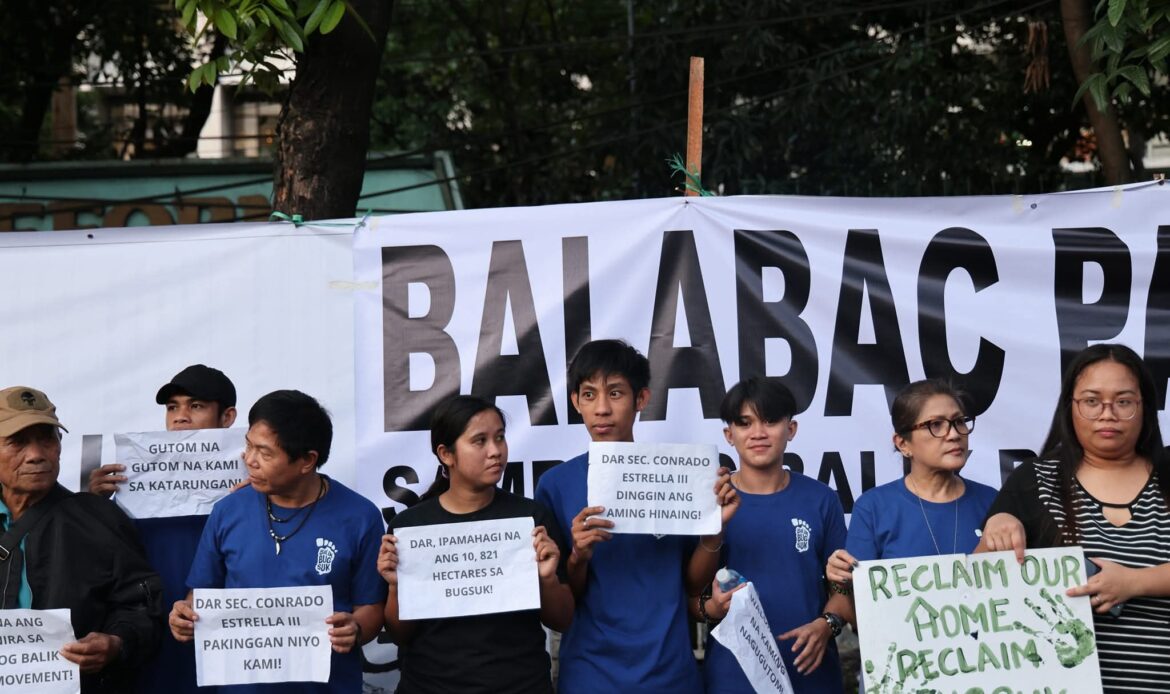
For the Marihangin Indigenous community in the Philippines, legal protection of their territory was meant to safeguard them against dispossession. In practice, the more than two-decade wait for recognition of their ancestral lands has coincided with escalating corporate pressure, violence, and criminalization that now threaten their continued existence on the island.
Situated in the southern Palawan Islands, the Marihangin community has faced repeated displacement through a combination of state-backed land dispossession, private development interests, and judicial harassment. What is happening today is part of a longer pattern of exclusion and forced removal in the region.
That pattern dates back to 1974, during the martial law era under President Ferdinand Marcos Sr., when more than 10,800 hectares of ancestral lands in neighboring Bugsuk and Pandanan islands were awarded to Eduardo Danding Cojuangco Jr, who became the CEO of San Miguel Corporation (SMC). SMC is one of the largest conglomerates in the Philippines today and is developing eco-tourism projects in the Palawan islands. Indigenous residents were forcibly evicted by state forces, and many displaced families sought refuge in Marihangin. Years later, the establishment of a pearl farm in the surrounding waters further restricted access to traditional fishing grounds and navigational routes, undermining livelihoods that had sustained generations.
In 2005, the Marihangin community applied for a Certificate of Ancestral Domain Title (CADT) before the National Commission on Indigenous Peoples (NCIP) to secure legal recognition of their territory. Twenty-one years later, that application remains unresolved.
But while the State has delayed recognition, pressure on the community has intensified.
In recent years, the company has adopted a divisive strategy toward the community, which has led to the withdrawal of agrarian protections covering Marihangin and to the advancement of development plans linked to large-scale ecotourism expansion in the surrounding area. Community members report that relocation offers were made to induce residents to leave the island, but most families refused.
Tensions escalated sharply in June 2024, when representatives linked to private land claimants and government officials attempted to enter the island to present documentation removing Marihangin from agrarian reform coverage. Residents blocked their landing and demanded that they leave. Days later, the authorized representative of the claimants, and a former director of the Ancestral Domains Office of the National Commission on Indigenous Peoples (NCIP), filed criminal complaints for grave coercion against ten community members, including two individuals who were not even present during the incident.
Two days after that complaint was filed, armed private security personnel deployed to the island. According to the community, security guards fired shots toward residents, including children, after being confronted by community members demanding their departure. Since then, armed guards have remained on the island despite community objections, creating what residents describe as a constant atmosphere of intimidation.
Today, the Marihangin community faces an expanding web of legal harassment.
Ten community members are currently facing grave coercion charges linked to a June 2024 incident. Although released on bail of PhP 360,000, the case remains ongoing. One of the 10 was convicted for a previous case of “illegal fishing”. Another community leader faces a cyberlibel complaint for publicly denouncing threats against the community and the lack of government protection. In addition, 282 residents, representing most of the island’s population, have been named in civil cases seeking to undermine their land claims, secure restraining orders, and impose damages.
One court-issued restraining order now restricts community members from conducting night watches and from building new homes on their land without risking fines. Meanwhile, the community’s own complaints regarding the armed security deployment, including complaints over gunfire directed toward children and a petition for injunctive relief against security personnel and associated actors, have progressed slowly through the courts and faced repeated delays.
For the Marihangin, the power imbalance is stark. On one side is an Indigenous island community reliant on fishing and subsistence livelihoods. On the other hand, there are corporate actors and private claimants with the resources to sustain prolonged litigation and security operations.
The legal burden alone is severe. Court hearings are held on mainland Palawan, requiring community members to travel by boat and van multiple times a month to attend hearings, testify, and process legal documents. The cost of travel, legal fees, and lost working time places an enormous strain on families already under pressure.
These cases are not isolated legal disputes. Together, they form part of a broader pattern of Strategic Lawsuits Against Public Participation (SLAPPs): legal actions used not primarily to win in court, but to exhaust, intimidate, and silence communities defending their rights.
The Legal Defense and Sanctuary Fund (LDSF) is supporting the defense of unjustly accused community leaders so that the SLAPP does not achieve its objective of ending with territorial defense. In this way, after decades of pursuing legal recognition through official channels, the Marihangin will continue to fight for the right simply to stay where they have lived for generations.


